U.S. Incandescent Regulation Found Invalid

Local researcher finds contradiction in incandescent light bulb laws

In 2007, congress passed the bi-partisan Energy Independence and Security Act (or EISA 2007) which included intentions to phase out incandescent light bulbs. According to the chart, 100 watt light bulbs would be phased out by Jan. 1, 2012, 75 watt light bulbs by Jan. 1, 2013 and by Jan. 1 of 2014, there will be no more 60 watt light bulbs available.

“To be perfectly honest, I hate fluorescent lights,” said Schulwitz. “So I looked up the law because they’re taking incandescent light bulbs away from me.”

While Schulwitz was able to find the bill where the impending regulation amendments were spelled out (Section 321(a) of EISA 2007), when he looked up 42 USC 6295(i), the corresponding section of the U.S. Code that deals with energy conservation standards for incandescent lamps, the amendments weren’t there.

“This was very confusing to me for the longest time,” said Schulwitz. “How could this happen? Lawmakers are not the type that are just going to make a mistake like this.”

So as his nature, he kept digging. He found that US Code 6295(i) was amended by Section 322(b) of EISA 2007, which struck out the first paragraph of section 325(i) of the Energy Policy and Conservation Act, or 42 USC 6995(i), and inserted a new paragraph which does not in fact regulate maximum wattage requirements.

“The very bill that passed wattage requirements, just a page or two later, repeals it,” noted Schulwitz. “They contradicted themselves, and since you can’t have a contradiction in law, the later section erased the contradiction and erased the maximum wattage regulations.”

Schulwitz said after he published his findings on Wikipedia, he believes some law makers noticed, because shortly after, a news article ran which claimed the ban had been overturned.

“But they never really corrected it,” Schulwitz said. “They just took away the funding to enforce the decision… You have a compartmentalized government structure where one end passes the bill that clearly says something, but another part has to compile coherent US code that can’t contradict itself and has to make all the pieces add up all while following the letter of the law.”

While he doubts his discovery will change anything, he still thinks it’s an interesting oversight and said he can’t help but wonder what other types of oversights exist.

How can it not change anything when the regulation cancels itself out??

Just like the EU lightbulb regulation is invalid due to not fulfilling its own requirements.

That is two major federations enforcing regulations that are invalid!

UN Mercury Treaty Phases Out CFLs!

Now CFLs are included on the list of items to be phased out by 2020 due to mercury content!

Wow! Isn’t that rather remarkable for a lamp which all the world has heralded as greener than green? What does Greenpeace, Friends of the Earth, Project Porchlight and all the other pro-CFL-activists have to say about this?

Rik Gheysens has just made an excellent summary of the whole conference and all that was agreed upon in the treaty: UNEP and CFLs

He also describes the 50 million US$ UN-en.lighten Project that I’ve mentioned earlier, in which Philips & Osram will get paid to flood developing countries with toxic CFLs for another 7 years! (As I hardly think they’re going to hand out free LEDs…) How about some PET solar or LED gravity lamps to replace kerosene, which is one of the stated objectives of the Project? As long as it’s with something truly green and not with toxic CFLs, I’m all for it. But I’m not for replacing safe incandescent lamps with toxic CFLs.

Don’t buy any more CFLs! 

Buy halogen lamps instead and wait for LEDs get better (the LEDs sold now are mostly a ripoff, for which you get very little light of very mediocre quality and untested life span).

CFLs for private use should be banned with no delay.

If incandescent lamps could be banned much quicker than that for no good reason at all, why not make a more decisive effort to get the toxic lamps off the market a s a p?

And the incandescent ban should be lifted immediately, as the incandescent bulb is by far the safest & most environmentally friendly lamp ever made! 

Update Feb 19th: Unfortunately, it seems that the UN treaty limits are set at 5 mg mercury, so that most CFLs will slip through the net anyway:

The wording is not final yet however the draft of the convention recently signed by 140 UN countries proposes a complete ban on manufacture, import and export lamps containing more than 5mg of Mercury from 2020.

International Mercury Convention Picks Wrong Lighting Target

:(

GravityLight!

Gravity light can replace kerosene lamps

Here is a copy of the of the original article by the inventors. Please visit the website for video presentation and more information.

GravityLight: lighting for developing countries

GravityLight is a revolutionary new approach to storing energy and creating illumination. It takes only 3 seconds to lift the weight which powers GravityLight, creating 30 minutes of light on its descent. For free.

Following the initial inspiration of using gravity, and years of perspiration, we have refined the design and it is now ready for production. We need your help to fund the tooling, manufacture and distribution of at least 1000 gravity powered lights. We will gift them to villagers in both Africa and India to use regularly. The follow-up research will tell us how well the lights met their needs, and enable us to refine the design for a more efficient MK2 version. Once we have proved the design, we will be looking to link with NGOs and partners to distribute it as widely as possible. When mass produced the target cost for this light is less than $5.

Why GravityLight?

Did you know that there are currently over 1.5 billion people in the World who have no reliable access to mains electricity? These people rely, instead, on biomass fuels (mostly kerosene) for lighting once the sun goes down.

Lift the weight and let gravity do the rest.

Lift the weight and let gravity do the rest.

The World Bank estimates that, as a result, 780 million women and children inhale smoke which is equivalent to smoking 2 packets of cigarettes every day. 60% of adult, female lung-cancer victims in developing nations are non-smokers. The fumes also cause eye infections and cataracts, but burning kerosene is also more immediately dangerous: 2.5 million people a year, in India alone, suffer severe burns from overturned kerosene lamps. Burning Kerosene also comes with a financial burden: kerosene for lighting ALONE can consume 10 to 20% of a household’s income. This burden traps people in a permanent state of subsistence living, buying cupfuls of fuel for their daily needs, as and when they can.

The burning of Kerosene for lighting also produces 244 million tonnes of Carbon Dioxide annually.

Our final prototype with ballast bag and bits. 

GravityLight vs Solar powered lighting.

A commonly held view is that solar powered lighting is the answer to these problems in the developing world. However a number of conflicting factors combine to complicate matters. Solar panels produce electricity only when the sun shines, so the energy needs to be stored in a battery to produce the light when it becomes dark. The amount of energy stored is dependant on the size of the panel, the size of the battery, and how much (if any) sun has shone.

However batteries, panels and lights are expensive, and beyond the reach of people with no savings. Solar lighting projects continue to provide lighting for thousands of people in the developing world, but the spread is slow because the cost is too high for individuals, so they need to be bought and installed by communities instead.

LED bulbs do not attract mosquitos like conventional bulbs.

Lower cost self-contained lamps are becoming more widely available, but batteries are the weak link, because they are expensive and deteriorate through use and over time. Very often, when buying a low cost solar lamp with an inbuilt rechargeable battery, a full third of what you’re paying for is the battery, and you will need to replace it every few years. Assuming you can get a new battery… The capacity is often reduced to save money which limits the use time, after which there is no light.

With GravityLight, however, it only takes a few seconds to lift the weight, which creates enough energy for half an an hour of light, whenever it is needed. It has no batteries to run out, replace or dispose of. It is completely clean and green.

Because there are no running costs after the initial low cost purchase, it has the potential to lift people out of poverty, allowing them to use the money they have saved to buy more powerful solar lighting systems in the future.

Credentials

We are Martin Riddiford and Jim Reeves, London based designers who have spent 4 years developing GravityLight as an off-line project. We work fortherefore.com, which has over 20 years of experience in designing and developing hand held computing and communication products for a host of pioneers including Psion, Toshiba, NEC, TomTom, Inmarsat, ICO, Sepura, Racal Acoustics, Voller Energy, FreePlay and SolarAid.

We’re using a tried and tested manufacturer who has the right expertise to make GravityLight. We have some links to partner organisations in Africa and need to do the same for India. If you’re part of an organisation and would like to get involved then please contact us. We are particularly looking for contacts in South America.

Visit our skunk-works website here www.deciwatt.org.

Our movie soundtrack kindly created by Belinda from the bush the tree and me.

Check out John Keane’s great Solar For Africa blog.

CFL Fire Risk?

Happened to stumble upon this entertainingly written blog article, about a very serious issue:

Build a home, work on it day and night, stick a Walmart CFL in it and burn it down

“We are in the finishing stages of a way too long project of building our own home and everything is up to current code or better and has been inspected by the county. So yesterday morning when we smelled what seemed to be an electrical fire we started to do some fast investigating. We went to the breaker panel first then the outlets and switch locations in the dinning room where the smell was the strongest. I then went outside to check the crawlspace vents to see if something was on fire under the house, and nothing.

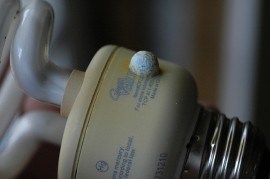
“So looking up I could see one of the CFL bulbs was no longer lit in a ceiling light and we could see a hint of smoke coming out of it. We flipped the light off and got our tall ladder out. Normally CFL’s are cool enough to unscrew even after they’ve been on for a while. Not this Chinese hunks of shit, it was hot as hell and was developing a zit in the transformer housing of the bulb. If it had been left unchecked there’s a pretty good chance it would have caught on fire. So a word to the wise IF YOU BOUGHT ANY GREAT VALUE CFL BULBS TAKE THEM BACK!”

“I’m really starting to believe that the Chinese are doing this on purpose, what a better way to fight a war than to have you enemy buy the weapons of mass destruction from you, and use them on themselves.”

The CFL ‘zit’ 

A CFL in recessed can starting to burn

A CFL in recessed can starting to burn

So, would the house really have caught fire or was this just the normal way for the CFL to expire?

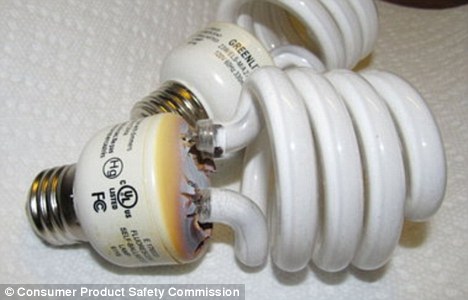
The U.S. Consumer Product Safety Commission (which welcomes product safety complaints) reports on 124 000 recalled CFLs due to fire hazard. And another case of 158 000 3-way CFLs.

CFL burn-out

CFL burn-out (image via Mail Online)

The Consumer Reports 2011 article, Bulbs pose fire hazard reports on another recall for the same reason:

“More than 300,000 compact fluorescent lightbulbs from Telstar Products have been recalled because they can overheat and possibly cause a fire, according to the company and federal authorities.”

And gives an explanation as to how this may happen:

“When a CFL can no longer light, its electronics still try to turn on the bulb, which could eventually overheat and cause the smoke and discoloration.”

However, government agencies and pro-CFL activists such as Project Porchlight, try to reassure us that this is no cause for concern, that actual fires started are rare, and that the foul smoke from dying CFLs is perfectly normal for this product:

It is normal for some CFL bulbs to smoke a little and even show signs of melted plastic on the ballast (the plastic base of the lamp) at the end of their lives. When CFL bulbs burn out, heat builds up in the ballast and the lamp’s safety feature kicks in: the Voltage Dependent Resistor (VDR) – an electronic component that cuts the circuit (like a circuit breaker).

I’m sure it’s not very healthy breathing in fumes from a smoldering or smoking CFL, even if it doesn’t catch fire!!

To minimise CFL fire risk, this is what the San Fransisco Fire Department advices:

The first and most important recommendation from the San Francisco Fire Marshal regarding any product with a
potential fire hazard is to read the instructions for installation, limitations and warnings that are provided with the
product.

Other important safety information (sometimes printed on the bulb itself) related to CFLs that, if overlooked, can
translate into a fire hazard are outlined below:

• CFLs should not be used in track, recessed or inverted fixtures
• CFLs should not be used with a dimmer switch unless clearly marked otherwise
• CFLs should not be used in place of a 3-way bulb, unless clearly marked otherwise
• CFLs being used outdoors must be enclosed
• CFLs should not be used in emergency exit fixtures or lights

I’d also recommend replacing CFLs before they burn out (literally) by themselves, something which you need to do anyway as they tend to get so much dimmer over time.

Do a little test and remove a CFL you’ve had for more than a year (if it has lasted that long) and put in an equivalent incandescent (like the one that you had there before) or a halogen energy saver just to compare the brightness and light quality. You may be surprised!

And never leave any CFLs (or halogen lamps) burning when you’re not home.

Swedish Consumer Tests Autumn 2012

There were two major Swedish tests made during fall 2012. Råd & Rön and Testfakta. The former is issued by Sweden’s leading consumer organisation, Sveriges Konsumenter, and the latter is a privately owned consumer testing company supplying independent testing of consumer products for major newspapers in Scandinavia.

Råd & Rön

Compact Fluorescent Lamps

I won’t bother making translated tables of the CFL data as they still have the same inherent problems as reported from earlier tests, so nothing new there. Instead I’ll let a translation of the CFL part of the Råd & Rön article summarise their test results:

The quality is more varying among the fluorescent lamps than in LEDs. Our test shows that there are many bad CFLs. Durability is a sensitive subject. Sure, only some lamps had gone out after 2000 hours. (We tested five samples of each lamp.) But many of the poorer quality fluorescent bulbs cannot withstand many on-and-off cycles. Philips Softone 20W can handle just a little over 5 000 on-and-off cycles. Manufacturers indicate lifetimes of 6 000 to 12 000 hours, resulting in a life expectancy of 10 years. This is hardly true for the worst lamps in the test. Sylvania Mini-Lynx Fast Start is a really bad lamp. As all lamps had gone out before 2 000 hours, we could not do the remaining tests.

Not for outdoor lighting

The fluorescent lamps have been on the market for a long time. Many have complained that they take time before reaching full brightness, and this is still the case. This is particularly true in low temperatures. There is a clear disadvantage if you want them in outdoor lighting, or for example in bathrooms and closets where you are anxious to reach full brightness quickly. Philips Softone Candle 8W for example, reached only 2 percent of its light output after 10 seconds when it was lit at plus 5 degrees and 1 percent of its light output at minus 10 degrees [Celcius]. The fluorescent lamps have also consistently slightly worse color accuracy than the old bulbs.

Well, lo and behold! This is the first time Råd & Rön have totally dissed the precious CFLs, even though these problems have been found in every one of their previous tests, and usually a lot worse too – as CFL quality has improved slightly over the last few years compared with the really really bad earlier specimens – which previous Råd & Rön articles have still insisted were mostly great, despite their own test results showing a different story.

So why this sudden change of tune? Ah, because now there is a new, even more politically correct lamp on the market, which makes manufacturers even more billions.

LED bulbs

From September 1st 2012, incandescent bulbs are no longer manufactured in the EU. They are very inefficient, only 10 percent of the energy becomes light, the rest is heat. They have been phased over several years and now the last models are gone.

Interesting that a supposedly independent and neutral consumer test article feels a need to insert the PR line about the alleged – but disproven - energy inefficiency of the now banned incandescent lamp. They don’t seem to realise that this is the equivalent of adding that one of the soda pops in a test “gives you wings” or “because your’re worth it!” when testing face creams.

And then the unabashed PR for their new pet lamp, the LED, just goes on and on:

Now even the LED are entering the market in a big way. They are even more durable and efficient than the fluorescent lamps. Previously, there has not really been models adapted for the fixtures we have in our homes. LEDs have also been very expensive. Now, there are LED lamps in a form that fits into standard fixtures. The prices are also coming down, LED – lights in our test cost from SEK 400 down to 100 each.

Oh hooray! Aren’t we lucky now that we can get a 400 lumen bulb (less than the equivalent of a 40W incandescent) for ‘only’ 10 to 40 €! Old bulbs were 5 SEK (half a euro) and gave a much better light. The lamp industry must be laughing their socks off all the way to the bank: “There’s one born every minute.”

Said to last for 25 years

LEDs are incredibly durable. We have in this test so far let them burn for 2000 hours, and only one copy of all the lights (we tested five samples of each lamp) went out during that time. Since previous tests, we know that LED bulbs can burn longer than that, 5,000 hours. We will let them burn as long this time and will be back with updates of the results. Manufacturers usually specify lifetimes for LED lamps of 15 000 – 25 000 hours, that is, a life expectancy of 15-25 years. There are values ​​that we obviously have not been able to verify.

So, how can Råd & Rön state as a fact that they are “incredibly durable”? Sounds more like a “probably the best lamp in the world” slogan to me. And why not actually test them for the full stated life? Or at least half? Then we would see how little light comes out of them by then, and how durable they really are.

LEDs are also very effective. They consume less energy than fluorescent lamps and much less than halogen lamps. Not to mention the old incandescent light bulbs – an LED bulb uses 80 percent less energy than an old bulb.

For this to be true, they would have to give 5 times more light per lumen than an incandescent, and consistently over time. From their own numbers I get a mean of 4.6 initially and this will decrease over time. Taking the heat replacement effect into account, this number should be cut in half. IKEA, Philips and other lamp producers often claim as much as 85% more effective to make it sound more worthwhile buying these hilariously expensive lamps instead of the CFLs that have now become less profitable.

Lights up at once

LEDs provide plenty of light as soon as you turn the switch, unlike fluorescent lamps. Another advantage is that LED lamps also work well at cold temperatures, the lamps actually work even better then. And even at cold temperatures, the tested bulbs light up immediately. Suitable for outdoor lighting in other words.

Well, not all of them: the Verbatim lamp took longer to light up, according to test data. But yes, LEDs are often a better choice for outdoor fixtures than CFLs in countries with cold winters.

One disadvantage is that the LEDs can have a well cold, almost bluish white light. They also reproduces colors slightly worse than halogen and incandescent bulbs.

But technology advances and the number of lights in the test have received a warmer light, and also a better color reproduction. Osram LED Parathom ClasA60, Ikea Conductors 8, 1W and Philips Led MyVision have received the best results for color among LEDs.

Yes, they are getting better. But they will still never be able to reach the same light quality as incandescent and halogen incandescent lamps because the light is still a composite light, from a mixture of phosphors trying to emulate the real thing.

If in doubt, ask to see how the LED lights in the store before you buy it.

This piece of advice is only partially helpful since the store is not dark. It helps you weed out the clearly blue-white, green-white or violet-white lamps. But as can be seen in my previous LED reviews, a warm-white lamp can look great in the shop. But then when you switch it on at home you’ll find that the colour is a bit off, that it produces a duller ambiance and generally doesn’t feel as good as more natural light sources such as sunlight and incandescent lamps.

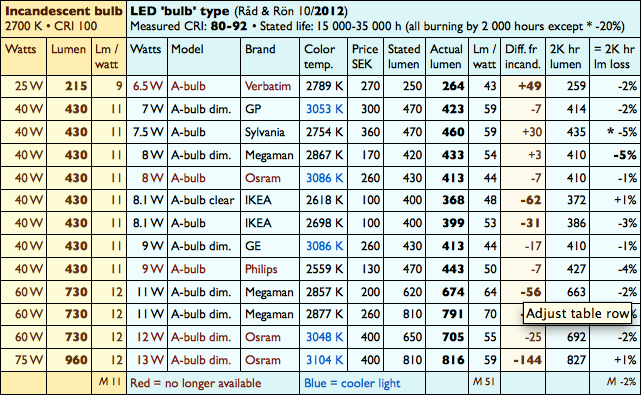
Here are the test data put into my own table for easier comparison with old incandescent lamps (click to enlarge):
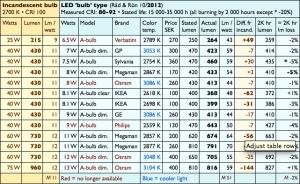
R&R 2012b LED

I will also add a copy to the Consumer Tests LED page to keep them all together.

Halogen bulbs

The Råd & Rön article continues:

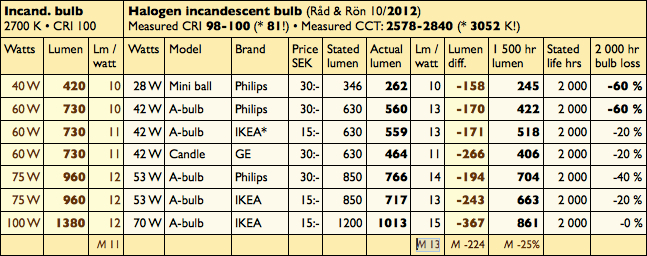
Halogen lamps, on the other hand, have good colour properties. They reproduce colors accurately, just like the old bulbs did. They are also considerably less expensive than both LED lamps and fluorescent lamps, and cost SEK 15-30 each. But they are far less energy efficient and have a shorter lifespan. Ikea 70W Halogen was the only lamp in our tests where all samples still burned after 2000 hours. This means a life of about two years and more promises nor manufacturers.

The table actually shows quite poor results for all the tested halogen lamps. All top quality when it comes to colour rendition and light quality, of course – except one IKEA lamp which also had a higher colour temperature, so they must have done something to it. But quantity-wise, these halogen energy savers appear only marginally more effective than the original equivalent incandescent lamps.

When this happens year after year, despite the fact that it is quite possible to produce halogen lamps with both higher efficacy and durability, I’m starting to suspect that this is by design so as to help these last incandescent-family low-profit lamps out of the market when up for review by the EU Commission in 2014. This is not acceptable!
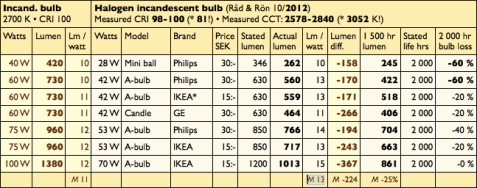
R&R 2012b Halogen

Testfakta

LED bulbs

This test doesn’t measure durability over time but some other interesting features such as flicker and how the light spreads. It also adds an incandescent lamp for reference. Translation of the test article [emphases added]:

Testfakta have investigated eight omnidirectional LED bulbs and compared them with their glowing predecessor. The lamps test correspond to about a 40-watt incandescent bulb in brightness and color temperature.

- One major difference lies in how LEDs spread the light. But what surprised me most was the time it took to light a couple of lamps, and some gave excessive flicker, says Håkan Skoogh, test manager at the Swedish Technical Research Testing.

Together with fluorescent lamps, LED technology is the incandescent-replacing alternative that provides the greatest energy savings.

The Testfakta test also shows that LEDs provide between five and seven times as much light per watt as incandescent lamp. While it differs as much as 30 percent between the most efficient lamp from Jula and the least efficient from Ikea.

- In this context, Ikea’s energy efficiency is on the low side. On the other hand, it has the good color rendering and these things usually go together – if you want good color, you often get poorer efficiency, says Håkan Skoogh.

But it is possible to have both high efficiency and high color rendering. It shows the overall test winner V-Light from Clas Ohlson, which is also among the least expensive lamps in the test. V-Light is the only lamp that comes close to the incandescent bulb’s ability to reproduce colors. Osram, Megaman and Cosna on the other hand, fall just below the limit of what is recommended for home environments.

- Unfortunately, this is a problem that we have to live with for a while in terms of LED technology. If you want the perfect color in the bathroom or above the hall mirror, for example, to see how the clothes match, you may unfortunately put up a halogen lamp instead, says Håkan Skoogh.

Another challenge for the LED industry is that the light from small LEDs is so directional. It is ideal for spotlights, but worse when you want to replace the incandescent bulb’s omni-directional effect. Laboratory measurements clearly show how most of the LEDs spread the light at an angle forward and not so much to the sides.

- If you have for example a decorative lamp with a side shade, then you want some of the light to come through it. But with lamps such as the Osram lamp, a large part of the light rather goes straight up to the ceiling.

The exception among the tested lamps is Connect from Jula. Here, the manufacturer uses another technology with a light guide that leads the light from the diodes and outward.

- It works quite well even if the light ahead will be somewhat weaker than in the bulb, says Håkan Skoogh.

There may also be advantages to different types of light scattering. Forward-facing light is preferable, for example, a desk lamp.

- It would be best if the producers had a light distribution curve on the package so that you as a consumer can see which bulb fits best.

The laboratory also examined how much flicker the lamps produce. Research suggests that flicker from screens and lamps can have adverse medical effects such as fatigue and stress. It was found that the lamps from Jula and Cosna flickered unnecessarily much.

- It shows very clearly and is not good. Flicker has primarily been a problem in old fluorescent and should not be in the LED lights. It must be about poor construction, says Håkan Skoogh.

Another thing that should not have to occur with LED technology is long ignition times. And yet the lamps from Osram and Star Trading clearly react slower later the rest.

- It is unnecessary and distracting, says Håkan Skoogh.
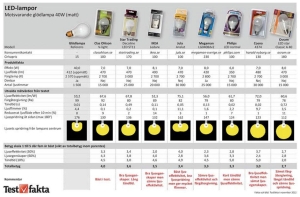
2012 LED Testfakta

Link to Testfakta test table

Article: Billig lampa ger bäst belysning

 

Darkness darkness

Happy New Year, everyone!

Hope your holidays have been good, with lots of love and beautiful lighting.

This post I’d like to dedicate to another, often forgotten, quality when discussing light: darkness. It seems fitting now during the darkest time of the year in my part of the world.

Don’t get me wrong, I love the summertime and have no wish to go back to living in a medieval darkness with only candles and fire light to read, socialise, travel and work by during the dark part of the day and year.

But our modern world has become almost insanely bright, at all hours of the day. Every last corner must be harshly and evenly illuminated with often cool bright light. We’re living in an era of literal enlightenment, and not all for the better. No room anymore for feeling, romance, mystery, subtlety or imagination.

And not so healthy either. Besides disrupting circadian rhythms in humans indoors, outdoor light pollution from over-illumination and poor beam control is also becoming a growing problem, not just for astronomers but for wild life as well: Ecological light pollution [Thanks to Peter Stenzel for the link.]

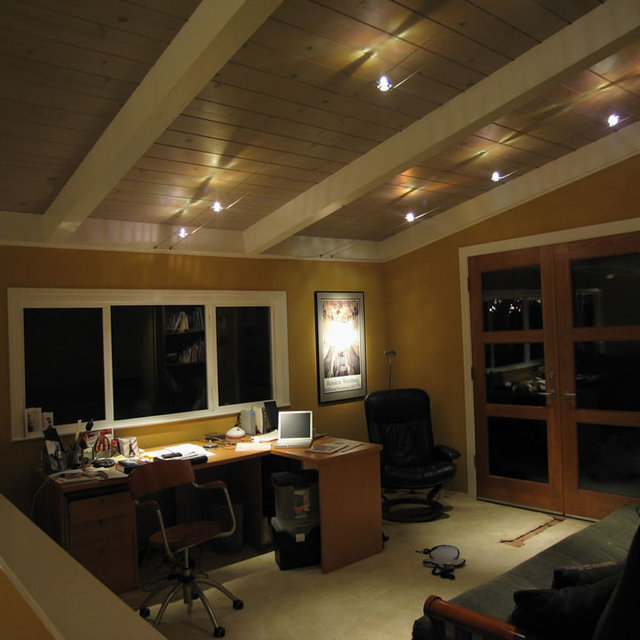
And is it not possible that some of us could work or learn just as well, or even better, in less over-illuminated classrooms, offices etc? Especially when sitting down, there is in my opinion no need for the whole room to be so extremely bright, as long as one’s desk or workspace has enough light. With computers, a bright ambience is even counter-productive. This is how offices could look, not just home offices like this one – and it wouldn’t cost more either!

Home office with halogen spots (image from: http://www.organize-utah.com)

Home office with halogen spots
(image from: http://www.organize-utah.com)

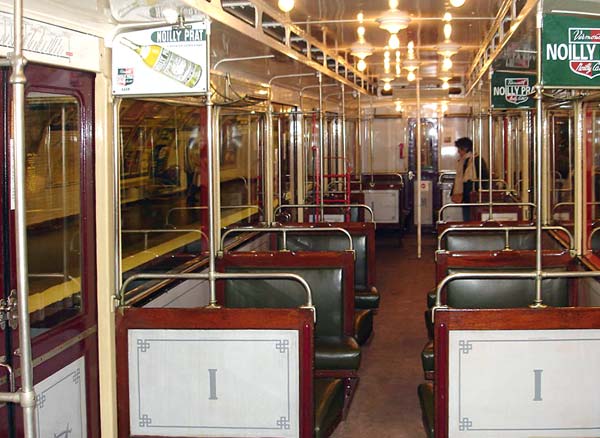
And why does public transportation need to be as harshly lit when one is just sitting there trying to relax to and from work, shopping or some social event, and not needing overly bright light to see every dandruff one’s your fellow passenger? A real mood-killer, isn’t it? Wouldn’t it be nice if your local public transportation was lit more like this old gem?

Sprague first class (image from: http://www.discoverfrance.net)

Sprague-Thomson train for Paris Métro, first class
(image from: http://www.discoverfrance.net)

And if the stations were more like the magical Grand Central Station in New York?

Grand Centeral Station(image from: http://www.jazzhostels.com)

Grand Centeral Station, New York
(image from: http://www.jazzhostels.com)

Unfortunately, the abundance of mediocre quality lighting follows a historical pattern. In earlier centuries, light was the luxury. A quality commodity like silk or gold. But with the arrival of cheaper, poorer quality gas discharge lamps and fluorescent tubes, suddenly it was possible to flood the general public in bright light at all hours of the day, just like we have been flooded with high quantity but low quality of many other things, from junk food and polyester to cheap reality shows.

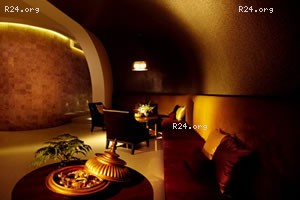
As I may have mentioned earlier, there are very clear rules and recommendations for lighting designers to use more quantity than quality for workers and cheap stores, and more quality than quantity for executives, high end boutiques, exclusive hotels, museums, spas, first class train cars, tourist buses, air planes etc, with more harsh, bright, flat and glaring fluorescent light for the former group and more dim, varied, warm, directional, and incandescent lighting for the latter.

Spa lobby, Bankok(image from: http://www.searchthai.net)

Spa lobby, Bankok
(image from: http://www.searchthai.net)

So, darkness, shadow and dimmer or more varied lighting has now become a scarcity, a rare luxury good like silence. Something the affluent few are made to pay premium prices for. But don’t we all actually need darkness just as much as we need light? Can we truly enjoy one without the contrast of the other?

I’ll let Jesse Colin Young & The Youngbloods end this little tribute to shadow and darkness:

CFL Mercury – Watch Your Feet!

I just stumbled on this link with the story of a man who dropped a too hot CFL globe lamp and could not avoid stepping on the mercury-contaminated glass as he stepped off the chair.

This “smaller than a ball point pen” amont of mercury, which CFL proponents try to dismiss as negligible and totally harmless, rotted away the man’s foot down to the bare bone!

(Warning! Very graphic pictures in the link so open at your own risk!)

Energy Saver Globe – Mercury Exposure

This could happen to you or your children or pets if a CFL was knocked over or dropped and accidentally stepped on.

New Philips-Apple LED Innovation

This new Philips RGB bulb can be set to almost any colour, just like other RGB lamps. But instead of a separate remote control, this one is controlled by an iPhone or iPad app, wich makes it a lot more flexible.

Specs given are: 8.5 watts, 600 lumens (equivalent of 50 watt incandescent) and not compatible with existing dimmers – although it seems that lamp brightness can be controlled via the app.

Here is a demonstration from Philips (the spoken text is in English so don’t be put off by the Swedish header):

It’s not available in my country (yet?) so I can’t review it (I also don’t have an iPhone or iPad and it won’t work on my Macbook or Android) so here is another video review instead:

The Apple store website has more reviews.

I’m glad to see new creative ideas being applied to LED technology, making use of what it does best: create coloured light, instead of trying to imitate incandescent lamps – which any non-incandescent light technology is predestined to fail at since you cannot reproduce the quality (glow, feel and colour rendition) of fire-based light without it containing the element of fire.

But very cool that light temperature can be set (and pre-set) to perfectly suit one’s mood and various activity levels during the day. How precisely that works in real life, and how well those settings reproduce existing colours, I’d like to see for myself, but I like the idea so far.

EDIT: Oh, now I saw that this “smart-lamp” was already invented by LIFX and launched in September. The presentation on kickstarter.com and the video on LIFX website shows the exact same features but also working with Android. Seems Philips ripped off the idea and made it an Apple exclusive. That’s not very creative.

And here was me starting to warm to Philips a bit. Ah well… 

Coloured LED Review 2

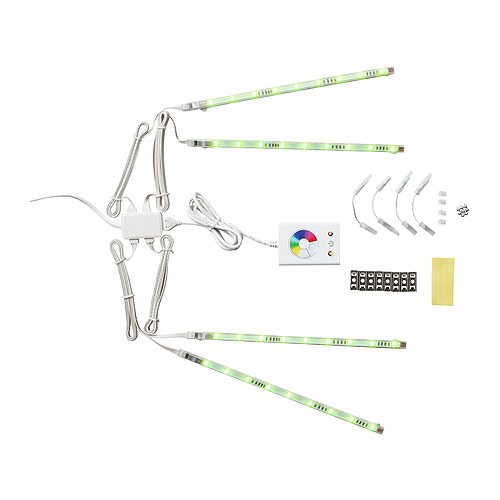
6W IKEA ‘Dioder’ RGB Lighting Strips

IKEA Dioder (photo: IKEA)

Info: 6W, 90 lumen, 20 000 hour life rate. Strips join together into either one long strip or at angles, e.g. around a small mirror.

Price: About €30.

Colour: All colours, easily picked with control panel. Can be set to monochrome, alternating or fading seamlessly through the spectrum.

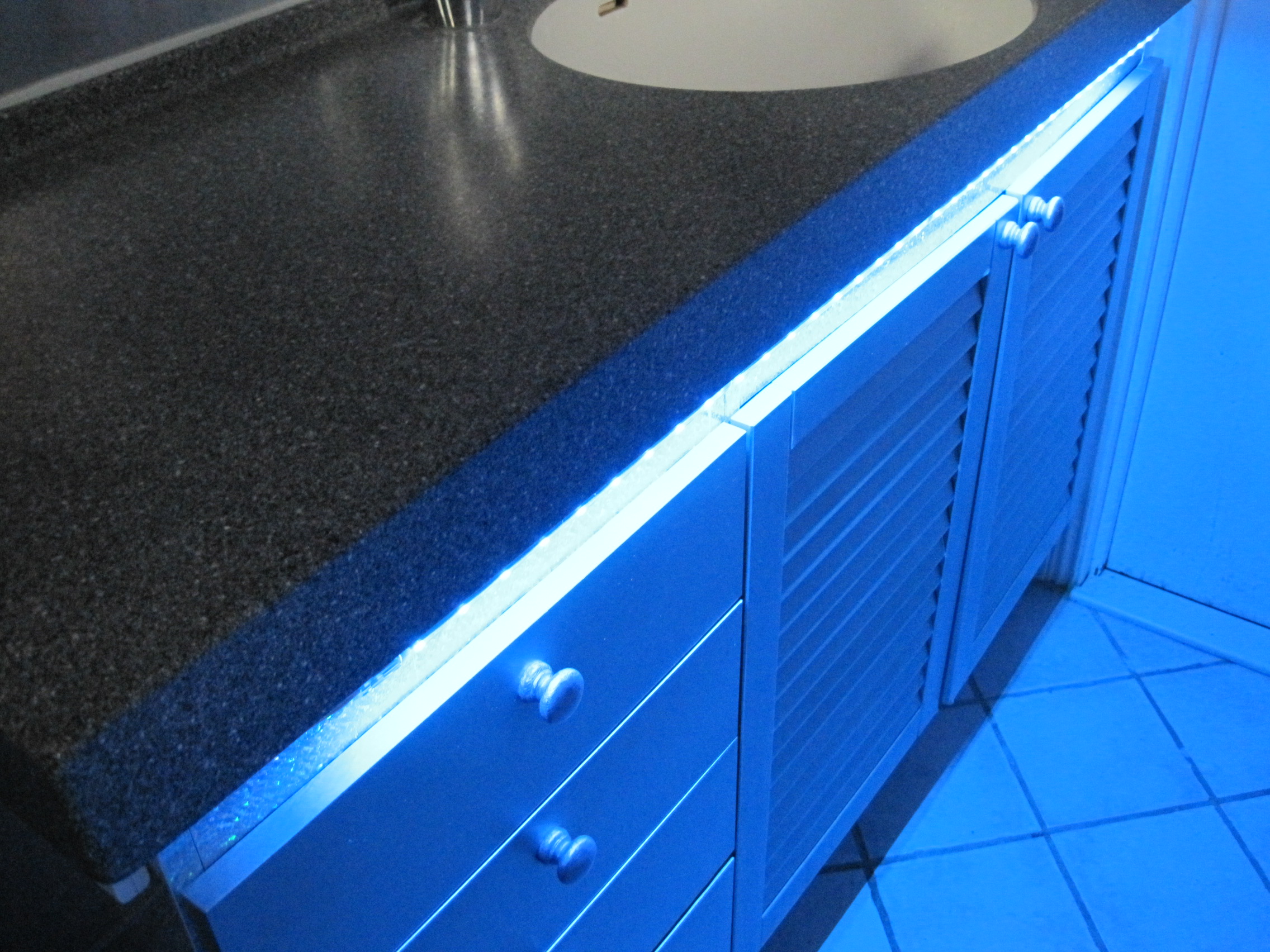
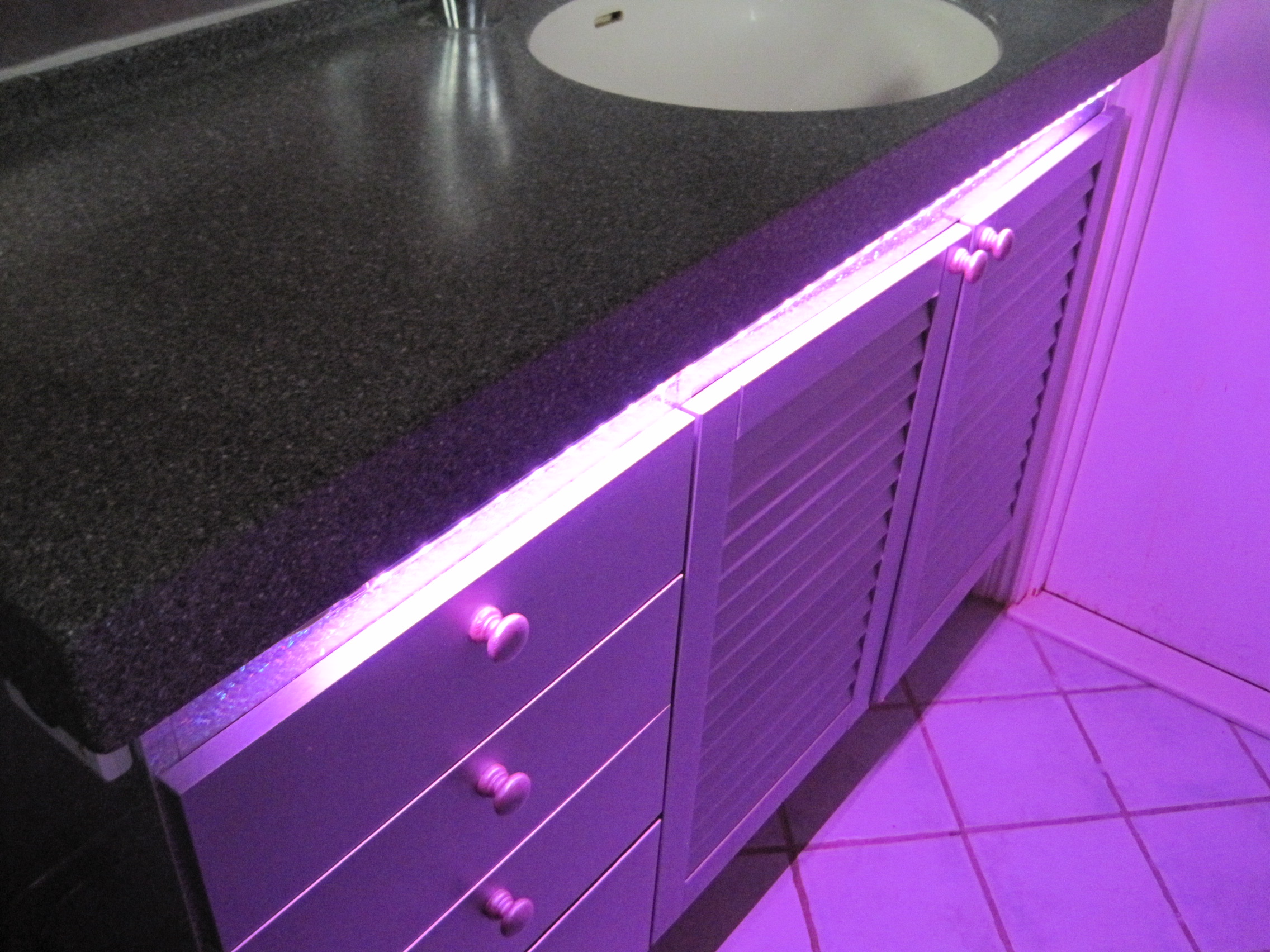
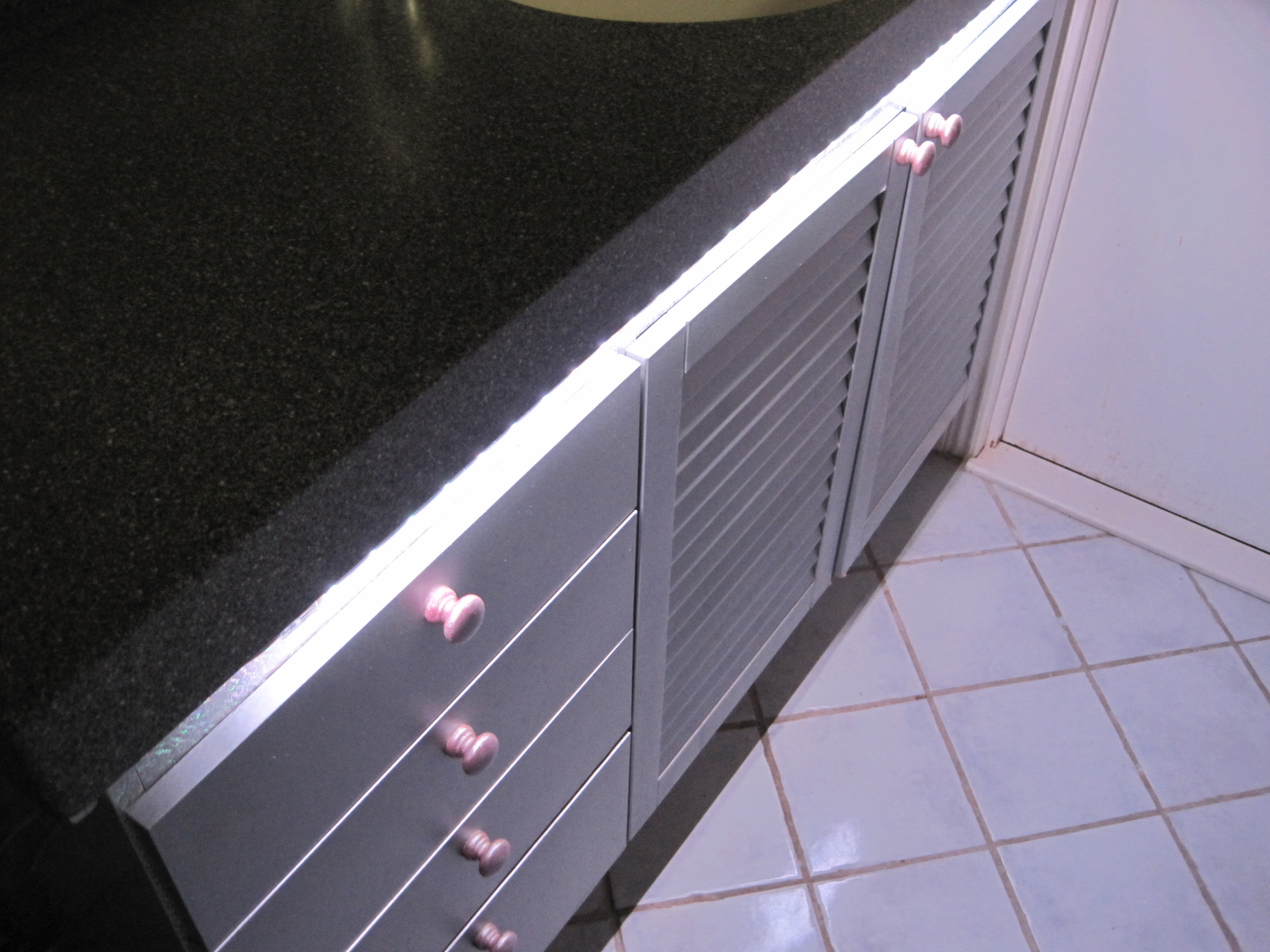
Impression: Great product! Very flexible design. More decorative than for illumination but it worked perfectly for the purpose I bought it for, which was to give a soft coloured light from under the basin cabinet while brushing teeth at night (as my bathroom lamps are not dimmable and I can’t stand bright light right into my eyes just before bedtime). So then I use the red setting, which is the darkest and the least melatonin-suppressing.

Red light (photo: Halogenica)

When I have guests or just want a change, I can use other colours and make my bathroom look really festive and colourful with just a click on the control panel.

Green (photo: Halogenica)

Blue (photo: Halogenica)

Violet (photo: Halogenica)

Cool-white (photo: Halogenica)

Love it! Unlike the gloomy excuses for ‘warm-white’ LEDs at IKEA, the varying colours on this one really cheers one up! If I had kids, I’d make a magic room for them with several of these.

I do have my doubts about it lasting for 20 years, but let me get back on that one… ;)

Warm-White LED Review 2

3W Philips ’MyAmbiance’ LED Candle Lamp

Info: 3W, E14 socket, clear, 136 lumen, 20 000 hour life rate.

Price: Over €10.

Colour: 2700 Kelvin, decently warm-white.

Impression: A similar design as the semi-opaque candle LED but clear. This one too looked nice enough in the shop that I had to try it at home. But alas, same thing again… Decorative design and decent light colour but the reflected light was just dull and gloomy, compared to the brilliant sunny warmth of incandescent light.

And I’m not trying to find fault with LEDs here. Quite the contrary. If someone could produce an LED that gave as nice a light as incandescent lamps, I’d be happy to give my incandescent advocacy a rest and leave well enough alone.

But it’s not good enough. At IKEAs the other week, a whole section of their lamp department was lit by LED lamps only, and the effect was sadly gloomy too. I can not imagine a future with only such poorer quality light available.

LED News Snippets

I’m starting to get really tired of all these LED articles and press-releases now replacing the over-optimistic CFL -pushing articles in the news stream, so sorry for starting out a bit grouchy. But I’ll report them anway.

1. First, this declaration from IKEA has been circulated widely over the last week:

IKEA Chief: We’re Leading America’s LED Lighting Revolution

In his dreams maybe. And our nightmare.

IKEA is setting out to change the way you light your home, one bulb at a time.

The Swedish retailer announced plans this week to become the first U.S. home furnishings chain to sell only LED (light emitting diode) bulbs and lamps by 2016 — a bold push for the widespread adoption of this energy-efficient light source in the American market. The world’s biggest home retailer will phase out its non-LED lighting over the next few years.

Which is none of its business! What happened to consumer choice?? I’m not sure if any promises were made to consumers by the U.S. Government, but the European Commission has promised continued availability of halogen lamps until 2016, so I don’t see how IKEA has a right to make them unavailable. But as the profit margin is now bigger for LEDs than for CFLs and halogen lamps, the decision makes perfect sense. IKEA has had nearly two decades to make huge profits on really crappy CFLs, and now they want to make even greater profits on to pushing crappy LEDs instead and removing all competing products.

Smart, from a business point of view, but not a consumer-friendly decision. As explained in previous posts, there are for example elderly and vision impaired who only see well in incandescent/halogen light. With LEDs there are dimming problems, higher price, poorer colour rendition and you get a gloomier ambiance in your home.

Integral to that plan is educating the U.S. consumer about the many benefits of LED lighting: LEDs are not only more eco-friendly than incandescent bulbs, but also use 85% less energy and are therefore less expensive over time, Mike Ward, president of IKEA USA, told DailyFinance.

Sigh… here we go again. For LEDs to use 85% less energy, they would have to produce about 100 lumen per watt. Even the best LEDs on the market don’t do that, and I very much doubt IKEAs LEDs counts among those, either in quality or quantity.

But selling the idea won’t be a slam dunk, as the initial cost outlay for LED bulbs far exceeds that of incandescent bulbs, Ward concedes. A 40-watt LED bulb costs about $12 at IKEA, whereas an incandescent bulb ranges from approximately 49 cents to 79 cents. But what most Americans (about 73%) don’t know is that LED bulbs last 20 years, according to Wakefield Research cited by IKEA. Incandescent bulbs, by contrast, last only about a year, Ward said.

Oh, I think they do know this since it’s being repeated with the same fervor as the earlier CFL PR slogans (which turned out to be totally false in real life). What consumers may not know, however, is that theirLED light will continue to get weaker and weaker with age, and be useless for illumination long before those 20 years are up. In which time much better lamps will probably have been invented and then you’re stuck with an outdated and increasingly poorly performing lamp for a decade or more.

2. Then Philips wants to blind us further with even more extremely cold and glaring LED car headlamps:

Philips Introduces New X-tremeVision LED Replacement Bulbs

These new X-tremeVision LED bulbs are available in two light color temperatures: 4,000 K and 6,000 K. The 4,000 K white light is much closer to daylight than a traditional incandescent interior bulb. The 6,000 K version takes it up a notch and delivers the bright white look of Xenon HID, yet consumes 13 times less energy, according to Philips.

Grrr. Why would anyone want daylight at night? That is totally unnatural. And trying to emulate Xenon HID is an extremely bad idea since they are the worst headlight lamps ever invented. See also my post Blue light hazard? for how blue light is more glaring and blinding than warmer colour temperatures, which is not exactly helpful in traffic! Extreme light is not what you want to meet on the road when driving at night. Is this a sort of empathy thing? Where the driver is meant to care only about his/her own visibility even if it blinds and endangers meeting traffic?

3. At least LED bulbs for home illumination are getting brighter:

LEDnovation introduces 75W- and 100W-equivalent A-lamps, warm-on-dim BR30

Good.

4. And some of them cheaper, for some markets [translated from Swedish article from earlier this year]:

Ledlampan spränger drömgräns (“LED lamp passes dream limit”)

The Dutch Lemnis Lighting which started selling a joint lamp for $ 4.95. The goal is to attract consumers who are hesitating to buy led lamps as the price so far has been high, often several hundred pieces.

The lamp is relatively simple and can not be dimmed. It delivers 200 lumens, much like a 25 watt bulb, but the effect is only 5 watts. Color temperature is 2700, which gives a warm white light. Colour rendering index, CRI, is 85, and life is said to be 15,000 hours.

So far the lamp only on sale in Lemnis American online store that caters to clients in USA, Mexico and Canada.

Lemnis Lighting has by his own admission has sold more than 5 million LED lights since 2006. When New Technologies in June 2010 tested LED lights representing 40 watt bulbs so got Lemnis candidate best results of the three tested.

One of the founders is also Warner Philips, the great grandson of the founder of lighting giant Philips.

Clearly not in Europe though. Skipping the dimmability I think is a good idea since they don’t dim nicely anyway. I would still not pay even $5 for a 200 lumen LED, but for those who don’t mind the lower light quality it’s good they are making an effort to bring prices down.

5. And innovations can improve function [another Swedish article from September]:

Ledlampan som vänder upp och ner på tekniken (“The LED lamp that turns technology upside-down”)

3M has developed a LED lamp that is unlike any other. While other lamp manufacturers put the diodes in the bulb and the driver electronics in the socket 3M does the opposite.

In a ring in the socket, ten diodes are placed that send the light straight up. The light passes along the contour of the globe, thanks to a waveguide spreading the light over the entire surface to radiate in all directions. Everything to mimic the light from a frosted lightbulb.

The driver electronics are inside the bulb, a slick solution because it is more spacious and airy there, compared to the socket where the electronics usually sit. Many LEDs therefore have bulky heatsinks to prevent the diods from getting too hot and lose both intensity and longevity. In the 3M narrow slits in the bulb helps ventilate the heat.

3M launches two wattages. One of 13.5 watts which provides 800 lumens and can replace a 60 watt incandescent bulb. The second is at 8.5 watts and provides 450 lumens, equivalent to a 40 watt bulb. Both are available in two versions for warm white and cold light. Life rate is said to be 25 years if you use the lamp three hours a day on average.

The new lights will be on sale in Walmart stores across the U.S. this fall. The price of the 13.5 watt lamp is as reported in the American press to be 25 US dollars.


Light Impressions Update

Last week I revisited the ‘Average Joe’ family to help them improve their lighting.

I came equipped with an assortment of different lamps from my well-supplied stash, including a few CFLs and LEDs, as those might be appropriate for some luminaires.

On closer inspection, it turned out they had replaced almost all their 60 watt incandescent lamps with 11 watt CFLs, like good and responsible citizens have been encouraged to do by their trusted authorities – despite the fact that you get visibly and measurably less light and poorer quality light from such an ill-advised switch. As described in my earlier post, the result was quite appalling.

Worst of all lamps was the one over the kitchen table, a dim yellowish CFL that made the whole kitchen very gloomy and hard to see in. The lovely elderly couple complained over the dimness but it never occurred to them to use another lamp because they had been told an 11 watt CFL should suffice and had missed that halogen replacements even existed. I put in a clear 53 watt halogen energy saver and it was like switching on the sun in their kitchen! The difference really surprised them. Now they could see!

I did the same in the 2 identical living room wall lamps. First I replaced only one of them to let them see the difference both in brightness and how the colour of their rusty red sofa looked more grey in the CFL corner. Also tried the Philips LED lamp and that too did not make colours as vivid as the halogen lamp.

Living room sofa – Halogen energy saver

The dining table already had a beautiful crystal chandelier with a halogen lamp in the middle so no need to do anything there.

A floor lamp with a dim 11 watt CFL got a 28 watt halogen energy saver. We tried different wattages but the family thought 28 W gave just the right cosy feel, with the light still clear enough to see well.

A table lamp that had a sad 7 watt CFL ball got a 15 watt clear incandescent ball. This corner was more grey and gloomy than it looks in this picture:

Table lamp – CFL

Here the difference in light clarity when it was replaced with an incandescent bulb shows very clearly:

Table lamp – Halogen

Then I replaced two frosted incandescent 15 watt ball bulbs in their window luminaires with clear ones. No reason to waste a frosted bulb behind a shade. This made only a slight difference of course, but I wanted to put the precious last specimens of the now extinct frosted bulbs to better use.

Living room window lamp 1 – Clear incandescent ball

The frosted ball got moved to the entrance window lamp (with the 7W CFL ball as backup for when it burned out) to replace a very unwelcoming blue-white clear 3W LED lamp with glaring little light dots seen through a partly clear glass shade.

Entrance window lamp – Frosted incandescent ball

Remember this rule of thumb, folks:

• Frosted or opaque lampshade where you don’t see the bulb – use a clear lamp.

• Clear lampshade, no shade or open shade where you see the bulb – use a frosted lamp.

The difference from these small changes was more striking in real life than shows in the pictures. Being very much an amateur photographer, I found it difficult to capture it on film as the camera keeps trying to compensate for what was lacking in the dimmer and poorer quality bulbs.

All in all, I added another 163 watts to their lighting use. If all those lamps are on an average of 5 hours a day all year, that would make about €9 per year, but as all lamps were indoors and about half the heat from the incandescent bulbs is estimated to help lower the energy bill, that makes about €4.5 per year. That’s about the price of one glossy magazine or two bottles of coke – to be able to both see well and have a nice ambiance in their own home for a whole year.

So do try for yourself and experiment with different lamps to see what type and wattage looks and feels best. It’s not going to cost you as much as you have been drilled to believe. Just turn the light out when leaving the room and it will cost you even less.

NRK CFL Test

Copy of an article posted yesterday on the Norway national television NRK website (translated from Norwegian):

LONG TERM TEST OF LIGHT BULBS:

These energy savers went out first

Nemko test of bulbs (Nemko)
10 of 50 bulbs has already gone out the long-term test. The picture was taken in the laboratory Nemko this week.

Compact fluorescent lamps from Osram Luxram and have poor life in long-term test.

Published 09/15/2012 17:15.

Every fifth bulb has gone out after only half of the specified lifetime. Bulbs from Luxram and Osram had especially poor performance in NRK test.

At the request of NRK Consumer Inspectors, Nemko tested the life of ten different bulbs. Five copies of each lamp were tested.

Now this long-term test has been going on for 5200 hours, which equates to almost five years in consumption if the bulbs are turned on for 2.7 hours each day.

10 of the 50 CFL bulbs have already packed it in, even though most of them are claimed last for 10,000 hours or more, according to information on the packages.

Five of the bulbs had gone out after only 2500 hours.

Luxram and Osram

In Nemko laboratory the bulbs are turned on and off at regular intervals, according to the international test standard.

The result so far allows two lamps stand out as very durable.

All five Luxram bulbs (11 W Energy Saver) has now gone out.

Compact fluorescent lamps from Osram and Luxram
All Luxram bulbs and three Osram bulbs have gone out at mid-term.

Moreover, three of the five bulbs from Osram (Duluxstar Mini Ball) have called it a night.

Approx price for these two bulbs were respectively 29 and 80 kroner, and both have a specified life of 10,000 hours.

One of five bulbs from Energetic (Energy Saver Warm White Bulb Classic) and one lamp of the North Light model from Clas Ohlson has gone out.

Best at other qualities

Although life is so-so, the Osram lamp became test winner as Nemko and NRK tested other qualities of a half ago.

The Osram bulb had good efficacy after both 100 and 1000 hours, and it starts quickly. Osram is admittedly more expensive than many of the others, but uses the least power in return. Read more about the test here.

- We regret the outcome of course, but are surprised by the result, says CEO Arvid Furru in Osram AS.

He questions the fact that only five bulbs of each brand tested. - If they originated from a batch that had a weakness, it may be an explanation for life. In Europe, selling tens of millions Osram series without errors each year, says Furru to NRK.no. He adds that Osram bulbs have three years warranty in Norway. - Customers may experience problems of this type, you switch to a new bulb by contacting us or the store where it was purchased, he said.

- Realistic

Lifetime of bulbs (Photo: Tor Risberg / NRK)
That the package says 10,000 hours / 10 years, does not mean you can expect a long life. Photo: Tor Risberg / NRK

- Luxram doing so badly is not surprising at all. Early in the test, it became clear that these bulbs have poor light output, which is further reduced after 1000 hours. And one of the five Luxram bulbs went out after only 1160 hours, said Erlend Lillelien, head of the knowledge center [national lighting industry representative] Lyskultur. He is more surprised Osram results. - The manufacturer is known for good quality, and these bulbs came out best in the remaining portion of the test. I hope the explanation for poor life is that Osram bulbs stems from a bad batch.

Head of Erlend Lillelien, Lyskultur (Lyskultur)
Information about life can be misleading, says Head of Erlend Lillelien in Lyskultur. Photo: Lyskultur

- But the test is realistic in the sense that all the bulbs are picked straight off the shelves, says Lillelien to NRK.no. He believes many consumers get the wrong impression when labels informs about a ‘life of 10,000 hours.’ - The internationally agreed definition of life is that half of the savings bulbs continue to burn after the 10,000 hours. It is not possible to produce bulbs with a guarantee that all last that long.

- Therefore, the information on the packaging to be rather confusing for the public, says Erlend Lillelien.

- Inadequate

Already in May, three of five Luxram bulbs burned out. CEO Frode Eng at Lampe magazine, which sells Luxram bulbs, admitted then that result is too bad. He, too, was surprised at the poor life, even if he thought it’s a bit unfair to compare the 29-kroner bulbs with others that cost far more.

- But of course we are unhappy with the result. Life indicated on the package of course should be valid, said Eng NRK.no the last time we summarized the test results. Now all Luxram bulbs in the test have burned out.

These are the other bulbs in the test, which have not yet gone out:

  • Philips Softone (T60WW827)
  • IKEA Sparsames
  • Megaman Ultra Compact Classic (GA911i)
  • FIXIT saving bulb
  • Biltema 11 W
  • Europris Power 9 W warm white

The test is still in progress. CFLi have an effect equivalent of between 48 and 60 watts compared with the old incandescent bulbs.

***************************

Halogenica comments:

1. Isn’t it funny that when tests reveal CFL bulbs to not last as long as claimed, the lighting industry representative “hopes” that it was due to “a bad batch”. How about a bad product?

2. And then the representative goes on to state: “The internationally agreed definition of life is that half of the savings bulbs continue to burn after the 10,000 hours. It is not possible to produce bulbs with a guarantee that all last that long. Therefore, the information on the packaging to be rather confusing for the public”.

Confusing is right! But I think fraudulent would be the correct word here. Imagine if the food or pharmaceutical industry said: “Half the products in this line may actually have gone bad by the expiration date. We understand that this must be confusing to our consumers, but it is not possible to produce a product that will keep until the marked expiration date.”

3. And the Luxram retailer thinks the test is unfair? While it does follow a certain logic that cheaper lamps can’t be expected to have the same quality as top brand bulbs, how is it unfair to expect a lamp to last as long as it says on the package? Especially when long life is one of its two major selling points?

4. Interesting also how the article author feels compelled to point out that the Osram lamp still made Best in Test on other qualities. Such as quick startup time and good brightness both after 100 and 1000 hours.

Well, a 100 hours into its life happens to be the peak of any fluorescent lamp’s life according to manufacturers, and good output after 1000 is no insurance of how good it will be after 3000 hours, or 5000 hours – if it lasts that long – or that it even gave as much light as promised in the beginning. Qualities such as colour rendition, dimmability etc are not mentioned at all. (Incandescent and halogen incandescent lamps are far superior in that regard, and startup time is not only quick but instant.)

I’m not at all surprised by these results. The CFL bulb models tend to lose more light and have shorter life than bare tube models due to being enclosed in that outer bulb, trapping heat which affects both life and brightness. And while the very thin diffusing layer on the inside of a frosted incandescent bulb has virtually no effect whatsoever on its light flow, adding another frosted bulb over the already semi opaque tubes has a marked light diminishing effect in CFLs.

It is simply a product which should never have been made, since there are already other lamps that do the same job so much much better.

Warm-White LED Review

This week I bought two LED lamps. I picked the ones that looked best in each store, to see how they would look in a home environment.

First up is the less famous cousin of L Prize lamp (previously reviewed by SaveTheBulb):

12W Philips ’MyAmbiance’ GLS Bulb

MyAmbiance in package

Info: 12W (12.5 really, but it’s marked 12W), E27 socket, 806 lumen (about 200 lumen more than most 60 W-replacement CFLs!), dimmable, 25 000 hour life rate, “Made in China”.

Price: Almost €70!

Colour: 2700 Kelvin, and truly warm-white.

Impression: First impression is how heavy it is! Almost 200 grams when I weighed it. A standard incandescent A-bulb weighs 25 grams. (Edit: grams, not kilograms.)

Brightest LED for home use that I’ve seen so far. Even quite glaring, so best used with a lamp shade.

While it looks very incandescent-like when you look at the lamp itself, the light from it is visibly not quite the same quality as that from incandescent lamps. Comparing it with the crystal clear halogen light it renders colours somewhat greyer. And when using it as the only light in the room, the whole ambiance turns a bit gloomy and dull, though more subtly so than lower quality LEDs and CFLs. And still the best I’ve seen so far.

Next I tried to dim it and got the similar unpleasant surprises as Kevan Shaw in his review above. 1) It immediately started buzzing! 2) Light colour got colder. 3) I was not able to dim it very far before it cut out altogether. But at least it didn’t fry my dimmer…

Edit: It also got very hot after I’d left it in for a while and tried to remove it again. Not as burning hot as a halogen lamp of course, but still enough to require gloves or leaving it to cool for a while.

I think I’ll use it as replacement for my 53W halogen porch lamp. Then I can leave it on when leaving home during the dark season.

Update: This is how it looked when I put it in. Good enough for outdoors, but the light is not quite as clear as that from the halogen lamp, and still has that ever-so-slight pink-white tint of all phosphor-coated light sources, though too subtle to catch on camera.

Update 9 Oct: I could no longer stand the unnatural fluorescent-looking pinkish light, so today this expensive LED got switched to one of the 60W carbon filament incandescents I’ve hoarded and now my porch looks nice and cosy again.

3W Rusta LED Candle Lamp

3W LED candle in package

Info: 3W, E14 socket, 1-diod, 100 lumen, 140 degree beam angle, non-dimmable, 25 000 hour life rate.

Price: About €9.

Colour: 2700 K and fairly warm-white.

Impression: This one caught my eye in the store as the lit demonstration lamp looked different than other LEDs I’ve seen in that it was somewhere inbetween clear and frosted, with a thick, semi-transparent, very cleverly designed inner glass that focuses the light and makes it look almost like a decent bright point replacement for a chandelier incandescent candle lamp.

3W LED candle

However, it disappointingly looked better in the shop (and in the above picture) than in real life at home. Light colour not quite as warm as such a low-watt lamp should be, more pinkish-white than in my photo. It also had a duller light and created a gloomier ambiance than my original incandescent lamp.

Funny thing happened when I put it in… As I held it by the painted metal base, it started glowing faintly blue at skin contact, even though the light switch for that particular luminaire was turned off.

*****

I think this will be all for a while. If these are the best lamps I could find on the household market today, I see no use in reviewing any of the lamps that looked inferior already in the store.

(If anyone thinks they have a lamp that is better than these, feel free to send me a sample. My mail address can be found on the About page.)

DEFRA CFL FAQ

Time for more Q&As from some typical pro-ban sites. These sites can be divided into categories:

a) Lighting industry representatives and lobby organisations
b) Energy saving lobby organisations
c) Energy labelling organisations
d) Utilites
e) Environmental organisations, websites & blogs
f) Government agencies trying their best to explain and justify the ban of their federal masters and/or plug CFLs as the greatest thing since sliced bread (now with LEDs as close runner-up).

None of the latter ever seem to double check the PR information they receive from the former. So, let’s have a closer look at a few of these constantly issued Q&As and CFL ‘Myth-busting’ pages. I will comment with the most truthful and updated information at my disposal.

DEFRA

First up is UK Department for the Environment, Food and Rural Affairs, DEFRA, on their energy savers info page. Even if a bit dated now (created at the first step of the phase-out) it gives such good examples of how the ban was spun then and keeps being spun now. The arguments have not changed much, as will be shown in subsequent posts.

The government has been working with all major retailers who sell light bulbs and UK energy suppliers to phase out traditional energy guzzling bulbs, replacing them with energy efficient light bulbs such as Compact Fluorescent Lamps  (CFLs). This is in advance of a EU-wide mandatory phase out of incandescent bulbs that began on 1 September 2009 and which was agreed by EU Member States in December 2008.

My comment: Auccumbinging to lighting industry lobby to get a national ban ahead of schedule is nothing to brag about… And “energy guzzling” (which the EU commission also uses to describe incandescent bulbs, despite them using less than 3% of home energy) is a juvenile phrase no doubt picked up from some ‘green image’ blog. It has no place in what tries to present itself as a respectable government information page.

The traditional light bulb has not changed for over a hundred years since Edison and Swan – the time of Queen Victoria – and these bulbs waste 95% of electricity as heat.

Cheap rhetoric trying to make them sound outdated when they are not. The haven’t changed much because they are already perfect! (If it ain’t broken, don’t fix it!)

And the heat is not ‘wasted’. While giving top quality light at home, it helps the house the same time. A 2003 study by DEFRA’s own Market Transformation Programme, found that throughout the year in a typical British house, about 60% of the energy from lighting turns into useful heat. (Same thing again as with the Swedish Energy Agency in my last post…)

Why have this initiative?

Climate change is the biggest threat facing our planet today. It is happening and it is happening now. Everyone – governments, businesses and individuals – needs to work together to tackle climate change by reducing our greenhouse gas emissions.

Yes of course. But if the EU Commission was truly serious about that, they would ban things that could actually make a difference, such as SUVs, junk food, soft drinks and bottled water, and start developing those alternative energy sources promised for decades. But that’s not going to happen, because they are not serious about it.

By phasing out the traditional light bulbs, we will all be using less energy so will need less electricity. CFLs are up to 80% more efficient then incandescent lamps.

First of all: no they are not. For a CFL to save 80% compared to an equivalent incandescent lamp, an 11 watt CFL would need to have an initial light flow of at least 730 lumen in Europe and 800 lumen in North America and lose no more than 6% over its lifetime. As both manufacturer catalogues even with their nominal lumen values show and consumer tests confirm, this is not the case. A scant few of the most effective top brand spiral CFLs now, over 30 years later, reach that number initially, but they still lose much more light over their life, even under optimal lab conditions. See also Equivalence Charts. With this + poor power factor + the heat replacement effect, they save not even half that.

Secondly, the percentage they claim to save is not the fictitious 80% (or more realistic percentages) of your entire electricity bill - it’s just made to sound that way – but of the small portion that lighting uses. And lighting uses on average less than 3% of total home energy consumption in the EU (3.85% in the UK) according to EU Energy Statistics, it can never be more than some percentage of those 3-4%.

What are compact fluorescent lamps?

They are small fluorescent lamps which fit into standard light sockets, usually referred to as CFLs or energy saving light bulbs.

They last longer and use less energy than traditional (or incandescent) light bulbs, because they are much more efficient at changing electricity into light.

CFLs are also cost effective. Advice from the Energy Saving Trust suggests that as they will last up to 10 times longer than a traditional bulb, just one energy saving bulb could save up to £3-6 a year and, depending on the length of time lights are in use every day, could save around £40 before it needs replacing.  Fit all the lights in your house with energy saving bulbs and you could save around £37 a year and £590 over the lifetime of all of the bulbs.

Funny how a government agency is so concerned with everyone’s private economy and doesn’t hesitate to forwards the inflated life rate & savings advertisement straight from the lobby organisation. Exactly in the same astounding way supposedly neutral agencies have acted in so many other countries. But perhaps not so surprising when the sources given at the bottom of their page are all lighting industry and their lobby organisations.

What other alternatives are there to incandescent lamps?

CFLs are the most energy efficient alternative technology, however halogen lamps are now available to fit into standard light sockets and emit light not dissimilar to incandescent lamps, but with only a 25-40% energy saving.

Not even 25% it turned out…

In the longer term, lamps based on Light-Emitting Diode (LED) technology promise to be highly-efficient alternatives even to CFLs.

The Energy Saving Trust’s website provide useful information on alternatives.

Already paving the ground for the even more profitable alternaties (profitable for the lighting industry, that is) and referral to one of the lobby organisations itself.

Are CFLs bad for my health?

Energy efficient light bulbs are not a danger to the public.

Like many household products, they must be disposed of sensibly and there are suitable facilities available for this purpose. Although they contain mercury, limited at 5mg per lamp, it cannot escape from a lamp that is intact. In any case, the very small amount contained in an energy efficient bulb is unlikely to cause harm even if the lamp should be broken.

True that it probably can’t escape unless the lamp is broken, but they cite no studies showing that it is harmless if broken. In July, 2011, a study showed that:

Once broken, a compact fluorescent light bulb continuously releases mercury vapor into the air for weeks to months, and the total amount can exceed safe human exposure levels in a poorly ventilated room, according to study results reported in Environmental Engineering Science, a peer-reviewed online only journal published monthly by Mary Ann Liebert, Inc.

The amount of liquid mercury (Hg) that leaches from a broken compact fluorescent lamp (CFL) is lower than the level allowed by the U.S. Environmental Protection Agency (EPA), so CFLs are not considered hazardous waste. However, Yadong Li and Li Jin, Jackson State University (Jackson, MS) report that the total amount of Hg vapor released from a broken CFL over time can be higher than the amount considered safe for human exposure. They document their findings in the article “Environmental Release of Mercury from Broken Compact Fluorescent Lamps.”

As people can readily inhale vapor-phase mercury, the authors suggest rapid removal of broken CFLs and adequate ventilation, as well as suitable packaging to minimize the risk of breakage of CFLs and to retain Hg vapor if they do break, thereby limiting human exposure.

Tests of eight different brands of CFLs and four different wattages revealed that Hg content varies significantly from brand to brand. To determine the amount of Hg released by a broken CFL, Li and Jin used standard procedures developed by the EPA to measure leaching of mercury in liquids and used an emission monitoring system to detect Hg vapor.

“This paper is a very nice holistic analysis of potential risks associated with mercury release from broken CFLs and points to potential human health threats that have not always been considered,” according to Domenico Grasso, PhD, Editor-in-Chief and Vice President for Research, Dean of the Graduate College, University of Vermont (Burlington).

Mercury Vapor Released from Broken Compact Fluorescent Light Bulbs Can Exceed Safe Exposure Levels for Humans, Study Finds

See also my earlier post: Mercury Problem Worse Than Suspected

Do CFLs contain mercury?

Yes, they need mercury to generate light efficiently. The mercury is used to produce ultraviolet light, which is then changed into light we can see by a special coating in the lamp. The coating is inert and poses no health risk.

Nowadays, the typical amount is 3 – 4 milligrams per lamp (and limited at 5mg per lamp) – just enough to cover the tip of a ball point pen and just enough to last the expected life-time of the lamp.

This reply immediately sets off my lobby alarm. That “ball-point pen” counter-argument is just one more in a long line of desperate attempts to downplay the still embarrassing and rather alarming fact that a supposed ‘green’ lamp contains mercury. I’ve seen it a thousand times on the internet. It seems to originate from – surprise! - Harry Verhaar, Philips Lighting, 2007 and was posted on Nils Borg’s energy lobby organisation eceee’s website:

However a number of concerns still exist regarding CFLs. These lamps contain minute amounts of mercury, which is needed to create light in an efficient way. Despite the fact that the mercury used would fit on the tip of a ballpoint pen, there is a justified worry about this mercury being disposed of in the ground. CFL’s fall under the EU WEEE recycling laws and it is expected that in the future the great majority will be recycled.

Why would a government agency with the stated mission “to protect the environment for future generations” try to downplay mercury contamination risks with minising statements like “the size of a ball point pen” – which may still be over the ‘safe’ limit when that evaporates and spreads in a room. Quoting an article I’ve cited earlier, Mercury in CFLs – special investigation (emphases added):

“First off, the often-cited claim that bulbs contain only 5mg of mercury was clarified: it’s an average. (..) The average amount of mercury in a CFL is 5 mg with a range of 0.9 to 18 mg. Obviously, the smaller (in watts) the bulb, the less mercury. Higher power (brighter) bulbs generally have more, although there can be fluctuations between brands as well.”

“‘Mercury concentration in the study room air often exceeds the Maine Ambient Air Guideline (MAAG) of 300 nanograms per cubic meter (ng/m3) for some period of time, with short excursions over 25,000 ng/m3, sometimes over 50,000 ng/m3, and possibly over 100,000 ng/m3 from the breakage of a single compact fluorescent lamp,’ the report confirms.

“That’s up to 300 times higher than the recommended safe level of inhalable mercury vapour. From just one light bulb. According to the DEP scientific study, while the 300 ng/m3 limit is the maximum allowable daily dose of mercury for the sake of legislation, there is in fact no known safe level for mercury exposure.”

Shouldn’t DEFRA know this? Isn’t that part of their job?

Will the mercury in CFLs cause damage to the environment?

Over the life time of both lamp types, energy efficient bulbs produce less mercury. This is due to the fact that mercury is emitted from power stations during electricity generation and energy saving bulbs are more energy efficient – therefore saving on the amount of electricity that needs to be generated.

Ah, here we got the next tired old PR argument that has been recycled over and over since early 1990s. This too is rehashed by Harry Verhaar via eceee:

However, mercury is also omitted in the atmosphere from the power system, and the mercury contained in lamps need to be weighed against that emitted from power plants. Studies show that indirectly the additional energy usage of incandescent bulbs is responsible for more mercury entering the environment than that is contained in a CFL.

This argument was invalid when it was created in 1991, and is even more so today. I believe was done on behalf of the Danish Market Transformation Programme, and spread via Nils Borg’s other energy lobby organisation IAEEL through other Market Transformation Programmes such as the Swedish one by STEM (see CFL Analysis – Mercury for more details, references and a pdf copy of the Danish ‘study’).

It was based on a fantasy calculation exercise at a Danish university in 1991, with an imaginary scenario of a CFL containing only 0.69 mg mercury (impossible to attain at that time, and still is), while electricity production from coal was assumed at a whopping 95% (as was the case in Denmark at that time but nowhere close to true for the rest of EU then, and even less so today). 

Of course, we’ve done a lot to reduce mercury emissions in the UK in recent years. Total emissions have fallen by 80% since 1990 and stand at 7.6 tonnes a year (2005 NAEI figures – see www.airquality.co.uk); power generation accounts for about 31% of this total.

Amusingly, DEFRA is clearly unaware that they just confirmed the invalidity of the first paragraph with the information in the second, (stating coal production is now only 31%) and the earlier point above (mercury content being 3-4, max 5 mg)!

This is what happens when you only repeat the arguments that the lobby organisations feed you, without doing your homework and actually understanding what you’re saying.

Does the mercury in a CFL pose a risk?

The mercury cannot escape from an intact lamp and, even if the lamp should be broken, the very small amount of mercury contained in a single, modern CFL is most unlikely to cause any harm.

But it makes sense to avoid unnecessary contact with mercury; and any light bulb – broken or intact – should be dealt with sensibly.

Again downplaying the risk, instead of warning of use around children, pregnant women and the elderly and sick!

‘Sensitive populations are of particular concern with mercury exposures for a number of reasons.’ ‘Elderly and unhealthy individuals may already be at comprised health and be more susceptible to mercury effects than a healthy individual. For example, mercury does kidney damage which could exacerbate an already existing kidney disease’.

‘Infants and toddlers have much more vulnerable brains.’ ‘Mercury exposures have serious impacts on fetal and infant brain development. Elemental mercury can cross the placenta from a mother to fetus.’ ‘It is well established that the developing organism may be much more sensitive than the adult to neurotoxic agents,’ reports Maine’s DEP study. ‘For example, methylmercury exposure can produce devastating effects in the fetus, including cerebral palsy, blindness, deafness, and even death, while producing no or minimal effects in the mother‘.

Source: Mercury in CFLs – Special Investigation See also Mercury in Fluorescent Lighting

Is a bulb likely to break?

Like all household products energy efficient bulbs can break, but they are actually harder to break than traditional bulbs: they are often coated with plastic as a protector and as they’re of a smaller diameter than traditional bulbs they’d have higher stress limits. According to trade figures, breakage rates are less than 1%.

Only some of the CFLs with outer bulb have an extra protective coating. Naked U- and spiral tubes do not. (Especially the spiral tubes seem particularly thin and vulnerable to breakage, but I’m not going to test that.)

An even if the 1% breakage rate reported by the industry reflected reality – which I doubt – that’s still a lot of broken CFLs! According to this Oxford report, “LIF (Lighting Industry Federation) estimate that 7 million CFLs were sold into the domestic [UK] market in 1999.” That makes 70 000 broken bulbs per year in the UK alone! (Can’t find fresher numbers but sales have probably more than doubled by now.)

How should I deal with a broken CFL?

Although the accidental breakage of a lamp is most unlikely to cause any health problems, it’s good practice to minimise any unnecessary exposure to mercury, as well as risk of cuts from glass fragments.

Revised advice issued by the Health Protection Agency is to:

  • Ventilate the room
  • Wipe the area with a damp cloth, place that in the plastic bag and seal it
  • Sticky tape (e.g. duct tape or similar) can be used to pick up small residual pieces or powder from soft furnishings and then placed in a sealed plastic bag. The plastic bag doesn’t need to be air tight, but should be reasonably sturdy.
  • Place it in another, similar bag and seal that one as well (this minimises cuts from broken glass).

The public should contact the local authority for advice on where to dispose of broken or intact CFLs as they should be treated as hazardous waste and should not be disposed of in the bin. All local councils have an obligation to make arrangements for the disposal of household hazardous waste at a civic amenity site or household waste recycling centre. The National Household Hazardous Waste Forum runs a website with details of these centres for chemicals, but which also applies to other hazardous wastes (www.chem-away.org.uk/). Alternatively contact your local council direct.

Mercury in CFLs – Special Investigation found this advice quite insufficient:

But the most up to date safety study available says plastic bags are next to useless for containing a broken CFL bulb.

“Double re-sealable polyethylene bags…did not appear to retard the migration of mercury adequately to maintain room air concentrations below the MAAG… The significance of this issue is that cleanup material may remain in the home for some period of time and/or be transported inside a closed vehicle, exposing occupants to avoidable mercury vapors when improperly contained,” report the Maine scientists. The best method of containing bulb waste is inside a glass jar with a hermetically sealed lid.

Surprisingly, plastic jars, like large peanut butter containers with screw top lids were little better than plastic bags, also failing to prevent mercury vapour from leaking into the house.

The scientific experiments proved that debris “sealed inside two polyethylene plastic bags and then placed in a clean room”, sent atmospheric mercury levels up to more than three times the maximum allowable limit, for more than eight hours – the mercury vapour simply leached out of the bags into the air.

“Of the 12 different types of containers tested during the 23 different tests, the plastic bag was found to be the worst choice for containing mercury emissions. Based upon this study, the DEP now suggests that a glass container with metal screw lid with a gum seal be used to contain debris.”

All of which means the current disposal advice given by New Zealand’s Ministry for the Environment is dangerously faulty, based on the most recent scientific studies. If a bulb breaks, disposing of it in two plastic bags will not prevent it from poisoning your house. Only a glass jar with a hermetically sealed screw-top lid is safe enough to hold the debris.

Clearly, many agencies around the globe have received – and posted - the same useless information on best clean-up procedures, thereby putting millions at risk.

How should I dispose of unwanted CFLs, e.g. at the end of their life?

From 1st July 2007, waste CFLs have been subject to the requirements of the Waste Electrical and Electronic Equipment (WEEE) Regulations. Those who sell items such as energy efficient bulbs must provide information to the public about where they can take waste bulbs and other WEEE. Some retailers will also take them back in store. However, most retailers have funded Designated Collection Facilities, in the main at local authority civic amenity sites. From this point, producers of the equipment fund the transport, treatment and recycling, where most of the mercury can be recovered.

This is a good and necessary step, but not everyone has the time, energy and opportunity to get their burned out CFLs to the right place for recycling, so the easiest thing would have been to simply ban the mercury-containing CFLs for home use in line with the RoHS directive:

  1. Lead (Pb)
  2. Mercury (Hg)
  3. Cadmium (Cd)
  4. Hexavalent chromium (Cr6+)
  5. Polybrominated biphenyls (PBB)
  6. Polybrominated diphenyl ether (PBDE)

Amazingly, CFLs are exempt from this hazardous substances ban due to their false claims of saving so much energy.

How does this amount compare to other articles that contain mercury?

A typical mercury thermometer may contain 0.5 to 3 grams of mercury, whilst a typical mercury barometer may contain 100 to 600 grams of mercury, around 25,000 to 150,000 times more than an energy saving bulb.

Again trying to downplay the significance of the mercury content in CFLs with another of the popular propaganda retorts handed out by lobby organisation for government agencies, environmental organisations and a gazillions of ‘green’ bloggers and commentating trolls to repeat ad nauseum, despite being totally meaningless:

What a typical thermometer contains is irrelevant since they are banned for that mercury content. According to this Canadian news site, 5 mg of mercury is “enough to make 6,000 gallons of water toxic“. (That’s why Canada decided against an incandescent ban.)

(The third popular retort is the one comparing with dental amalgam. DEFRA very wisely skipped opening that can of worms…)

Is the light from CFLs bad for my skin?

In October 2008 the Health Protection Agency issued precautionary advice regarding the use of certain types of CFLs in close range for periods of time over one hour. Their advice is that that open (single envelope) CFLs should not be used where people are in close proximity – closer than 30 cm or 1 ft – to the bare light bulb for over 1 hour a day. At these distances CFLs might emit Ultra Violet (UV) light at a level less than equivalent to being outside on a sunny summer’s day.

If bulbs are required at these distances then an encapsulated (double envelope) CFL should be used. These are cost around the same as open CFLs and offer similar levels of energy savings.

All CFLs are safe for normal usage and the HPA does not advise removing CFLs from your home.  More information can be found on the HPA website.

Through EU legislation, mandatory limits will ensure that all CFLs will not emit UV light above safe levels from September 2009. The European Commission’s Scientific Committee on Emerging and Newly Identified Health Risks also published a report into this issue recently and this can be found on the EC website.

Good, but I don’t think they’ve actually done much to enforce such a needed supervision. SCENIHR seems to accept most of the industry claims that their lamps are perfectly safe. See these posts on Health issues for more details.

What about those with light-sensitive conditions?

The Government has been in discussion with groups representing a small number of individuals for whom the use of CFLs can aggravate pre-existing light-sensitive conditions. The Government was successful in pressing the European Commission to introduce mandatory standards for UV emissions.

The Commission’s Scientific Committee on Emerging and Newly Identified Health Risks published a report into this issue recently and this can be found on the EC website.

As an alternative to CFLs, halogen lamps (like the one pictured) are now available for use in standard sockets which operate in a similar way to incandescent bulbs, however these offer only relatively small energy savings.

That “small number of people” are estimated by SCENIHR to be around 250 000 in the EU. And asking the affected themselves, it seems to be rather 2 million in the UK alone! Ban on incandescent bulb in U.K raising concerns on health issue of two million people

Don’t efficient bulbs take a while to warm up?

Modern, good quality, efficient bulbs should take little more than a couple seconds to warm up to full brightness, the short delay is due to the way they work.

They best CFLs have generally gotten a bit faster, but according to the latest CFL consumer tests, there are still big variations in start-up time between various CFL models. They are generally not (even by the EU Commission) recommended for bathrooms, closets, stairways and other spaces you only visit briefly and need full light instantly.

But aren’t efficient bulbs too big for most fittings? And don’t they give off  ‘gloomy’ light?

The technology of energy efficient light bulbs has improved massively in recent years. Manufacturers have now developed “look-alike” bulbs for the majority of light fittings and they give the same standard and quality of light as existing bulbs and in the same shapes.

At the moment, many efficient bulbs are not compatible with dimmer switches. However dimmable bulbs are on the market and will be made increasingly available in the UK during the phase out period. As an alternative to CFLs, halogen-based lamps are now available for use in standard lamps sockets, though these only offer relatively small savings.

In the past, the variety of colours available from CFLs was limited and they usually came as a ‘cold blue’ colour. Energy efficient bulbs now come in a range of colours from the original ‘cold blue’ to the traditional ‘warm white’ that you get from incandescent lights. Look for the Energy Saving Trust’s ‘Energy Saving Recommended’ logo as these have to emit the same warm light level as old fashioned bulbs.

True that the best CFLs look decently incandescent-like now. But they still only have limited colour rendering capacity (CRI 81-83).

True that there are more models now to fit a wider variety of luminaires (light fittings). But there are still many home luminaires where the replacement lamps don’t fit well (I have a few myself), or are unsuitable for other reasons.

True that there are now a few dimmable CFLs, but they are very expensive and don’t dim very nicely. But at least they may not fry existing dimming circuits like standard CFLs.

True that there are halogen energy savers, and that these dim beautifully. But only clear ones are permitted, which can be quite glaring at full power.

Aren’t these bulbs more expensive?

Whilst the upfront cost of efficient bulbs can be greater than traditional bulbs, according to the Energy Saving Trust efficient bulbs last up to ten times longer than a normal bulb and can up to £3-6 a year each in energy bills (for a 100W bulb), saving consumers up to £60 over the lifetime of the bulb in reduced energy bills and replacement costs.

Retailers are now selling efficient light bulbs at prices well under £1, and in some cases prices are not much more than traditional bulbs.

If the CFL is ‘cheap’ it is often either poor quality, and/or subsidised with (your) tax money (see CFL Subsidies).

Life rate varies widely between models, individual lamps and how they are used. Many either burn out prematurely or get so dim with age they have to  be replaced before they burn out. In such cases, savings are not what those ideal numbers promise. But quality has been improved somewhat over the last years since this FAQ was written.

Doesn’t switching the lights on and off use more energy than leaving them running?

No. Switching on an energy efficient bulb only uses the same amount of power as leaving it on for a minute or two. Turning the bulb on and off repeatedly may shorten a bulb’s life but normal use should not do this.

The recommendation from Osram is to leave them on for at least 15 minutes before switching off again. More frequent switching than that may dramatically shorten life.

A study published in 1998 examined CFL performance with five different operating cycles. It found that when the length of time the lamps were on was reduced from 3 hours to 1 hour, the lamp lasted for 80 percent of its rated life. When reduced to 15 min and 5 min, the lamp lasted for 30 percent and 15 percent, respectively, of its rated life.

Even the pro-CFL Energy Saving Trust confirms that frequent switching may reduce CFL life:

Regularly flicking a bulb on for a brief moment and then off again is not recommended as it can shorten the lifetime of the bulb.

See my post CFL Analysis – Life Span for more details and sources.

Does the law require me to replace all my traditional light bulbs immediately?

No; while the intention of both  the UK’s retailer-led voluntary initiative is to phase out the sale of inefficient bulbs in participated retailes, the EU’s mandatory measures under the Energy-using Products Directive will phase out the manufacture and import of inefficient bulbs and retailers will be able to sell on existing stock if they so wish.

So what is the timetable for these bulbs being phased out across the EU?

  • 1 September 2009 – From this date, manufacturers will not be able to place on the market clear lamps equivalent to 100W incandescent lamps, or above, must be minimum C class energy rating (leaving only halogen retrofit halogen lamps). Non-clear (frosted / pearl) lamps must be minimum Energy Label A-class.
  • 1 September 2010 - From this date, manufacturers will not be able to place on the market 75 W clear incandescent lamps.
  • 1 September 2011 - From this date, manufacturers will not be able to place on the market 60 W clear incandescent lamps.
  • 1 September 2012 - From this date, manufacturers will not be able to place on the market all remaining clear incandescent lamps (i.e. 40W and 25W).
  • 1 September 2016 - Raising the minimum level to B class for clear retrofit lamps (i.e. phasing out C-class retrofit halogen lamps).

Where can I find out more?

Page last modified: 29 October 2009
Page published: 11 January 2008

Heat Replacement Effect Again

Friday evening, something rare happened in conformist Sweden (where no article may be published without praising the politically correct lamps):

On prime-time national news, a representative of the Swedish Energy Agency (one of the strongest anti-lightbulb forces in Sweden*) was caught blatantly lying about the incandescent lightbulb. Can be viewed here for another 5 days (at 9:55 in the clip): Rapport 31 Aug, 19:30 My description, transcription and translation to English, reporter in green, his narrative in citation marks:

News anchor: From tomorrow the lightbulbs will be gone. The Energy Agency thinks this is an important measure for the climate and claims this will save energy comparable to the heating of 80 000 houses. But it turns out that the Agency uses exaggerated and outright erroneous numbers.

Cue Energy Agency representative Peter Bennich, turning on a an incandescent bulb:

- Well, this is a very nice light source, but unfortunately it uses a lot of electricity. So therefore it will be phased out. 

Then an elderly man in a lamp shop is interviewed while buying incandescent lamps:

- You’re stockpiling?

- Yes, absolutely! These modern lamps are so horrible, strange colours and… 

Clip new picture of lawn mowing.

“Environmental bombs like old lawn mowers and two-stroke engines are allowed but lightbulbs are banned.”

Back to Peter Bennich again (filmed at the Agency in front of a huge flat screen TV):

- They waste so much. It’s like buying 10 liters of milk and throwing away 9 liters every day.

“Only 1/10 of the electricity is of any use in a light bulb, the rest is pure waste. This is what the Energy Agency says.” (Document of the statement is shown.) “And this way we will save 2 TWh, 10% of the electricity in Sweden. This is the equivalent of 80 000 [electricity-heated] private homes they claim.”

- It saves at least 80% compared with the other lamp, says Peter Bennich again (likely referring to the CFL or LED).

“But something has been forgotten….”

Back to the man in the lamp shop:

- I have electric heating at home. The radiators turn on less frequently when I have the lamps lit.

“Lasse is quite right. If a lot of the of the electricity used for lamps is turned into heat, it logically follows that one can just turn down radiators a little instead. Most Swedish houses need heading, during most of the year anyway.”

Back to the Energy Agency and Peter Bennich again to check:

- Is it true that 90 % is pure waste? 

- Yes, that is my opinion. 

“In the Energy Agency propaganda incandescent bulbs are presented as only wasteful.” (A leaflet is shown.) “But the Agency has made their own calculations that show that throughout a whole year, not all but about 50% of the heat from the lightbulb is useful.”

Presented with this undeniable fact, Peter Bennich tries to spin it the other way:

- Well, it turns out then that max 50% of the heat from incandescent lamps are of any use… 

“Oops, earlier it was 10% that was useful. The truth was 50%! Which means that then the 2 TWh savings are not true, and not the other numbers in the information either. For those who want to save energy at home, there are much worse climate villains than the little lightbulb.”

Then the reporter presents Bennich with an infrared heater and a lightbulb, and turns up the heat in his questions:

- If I use this [lightbulb] as a reading lamp for half an hour every day for a whole year except June, or use this [infrared heater] for one evening, which uses most electricity?

Without even a second’s hesitation Bennich replies:

- The incandescent bulb! 

- No.

- Yes, Bennich insists.

“Wrong again. My reading lamp uses 2.7 KWh per year in my example. The patio heater uses 3.6 KWh after only 3 hours!” 

“But”, the reporter seems compelled to add (probably to not get in trouble with his superiors), “if you look at all of Sweden, the ban can still save energy.”

He then lets Bennich get the last word (despite just having proven what that word is worth):

- Lighting uses a very large part of electricity use in Sweden. 

- It sounds as if we are not very good at turning the lights off when not in use?

- Yes! We Swedes are extra poor at turning lights off. 

***  The End  ***

Fascinating, isn’t it?

Note how the Energy Agency representative is extremely careful to use the word ‘electricity’ rather than ‘energy’. That is a very deliberate  and well-coordinated strategy in order to make lighting part sound more than it is, as electricity itself is only a smaller part of total energy consumption.

It’s not a lie but it’s not telling the whole truth either. The largest part of most households’ total energy consumption is space heating (or cooling in warmer areas) followed by water heating. Lighting is only a small fraction of the remaining household electricity. EU average according to official statistics, is less than 3% of total household energy use – of which an estimated 46% was already fluorescent or halogen at the time of the ban (!) according to the preparatory study that was used as foundation for the ban (see my post EU Energy Statistics for details and references).

What is also deceptively concealed is the fact that the largest lighting part of national electricity use is in the commercial, industrial, public building and road illumination sectors, which use the most number of lamps, the highest wattages, and keep them turned on for most of the day or night. And most lamps in these sectors is already fluorescent or gas discharge! Some of them can still be optimised with newer and more efficient lamps of the same or similar lamp groups, better control systems etc, and by being turned off when not in use. That’s where the real savings on lighting can and are being made!

Whereas the private sector lighting use is such a microscopic slice of the total energy pie that it can easily be saved without banning any lamps.

I am sadly becoming more and more convinced that this whole lamp issue is just a diversion to keep us all believing that both we and politicians have really made a difference now by switching a few lamps. The planet is saved and we can all go back to sleep and keep consuming as usual. While the multi-billion-dollar CFL and LED industry is laughing all the way to the bank.

When the truth is that no one wants to rock the boat and start restricting the things that really pollute and deplete resources. Such as petrol-fueled cars & airplanes and the gazillions of electrical gadgets, clothes, trinkets and junk food we’re continuously being prodded to buy more and more of. No restrictions there.

__________________________

* The Swedish Energy Agency (STEM) has been leading the Swedish part of the global Market Transformation Programme (away from incandescent lamps) all through the 1990s until now. As I reported in The Global Anti-Lightbulb Campaign post, Kalle Hashmi, Executive Officer of Technology & Market Unit at the Swedish Energy Agency, in his Market Transformation Programme paper from 2006 admitted that:

STEM does not necessarily enjoy a commanding or trusted position vis-à-vis the consumers due to previous campaigns launched by STEM during the 90s. These campaigns may be summed as:

STEM engaged in ill conceived, inconsistent and ad-hoc promotions.
STEM did not take into account the consumer perspective but rather concentrated exclusively on energy efficiency and technical issues.
STEM relied indiscriminately on the information provided by the vendors.
STEM was very passive about dealing with CFL technology failures that affected main benefit claims.
STEM did not study, did not know or admit technology limitations.
STEM did not demand or work to establish minimum performance requirements.
STEM never questioned why long life claims were not backed by a guarantee.

And it seems that they’re still at it…

Incandescent Light Quality

Bye Bye Light Bulb – Do NOT Rest In Peace!

Now the last standard incandescent bulbs (15W, 25W, 40W) are banned from production and import in the EU. Remaining stocks may still be sold. Small special lamps, some decorative and rough service lamps will still be available (see Freedom Lightbulb for details). Reflector lamps will be restricted from next year and most incandescent halogen lamps from 2016.

This is truly sad because there is NO replacement for incandescent light quality, because the alternatives do no not produce light by incandescence (glow) but by technical, electronic and chemical processes which create radically different light properties, besides containing both more electronics and more potentially toxic, environmentally destroying or rare and expensive substances.

Here I’ve made a rough overview of lamp types family tree:

Whereas standard incandescent lamps and halogen incandescent lamps can be said to be ‘siblings’, all other lamp types have nothing more in common with incandescent lamps than being powered by electricity.

So, no matter how much effort is put into creating a phosphor mix that will superficially look more or less incandescent-like, it will just never be the same because it is a chemical composite light, a sort of digital soul-less light, totally lacking the warm natural glow of incandescence.

Banning a top quality product in favour of totally different and quality-wise inferior products is like banning wine with the argument that “wine-lovers can just as well drink cider, practically the same thing” because both are mildly alcoholic beverages with a superficial similarity. Or banning silk because there are micro-fibre materials with a silk-like look – everyone knows it’s not the same thing! Both have their respective uses and both should naturally be available on the market unless harmful.

What’s so special about incandescent light then?

Incandescent light (along with sunlight) is the ‘gold standard’ against which all other types of light is measured (even according the Global Lighting Association, p. 10 in this document). This is why so much effort has been put into trying to copy its light colour, colour rendering capacity, dimmability, heat- & cold resistance, perfect power factor and other unique qualities – without ever having hope of succeeding on more than the most superficial levels, because:

• Unlike other artificial light sources, incandescent and halogen lamps are tungsten black-body radiators, a safely contained and electrically amplified version of the same fire-light which humanity has evolved with since fire was first discovered. Lighting designer Ed Cansino in a highly informative interview:

“…if I were forced to choose the best lighting for residential overall, it would have to be incandescent. I feel that we as humans have had a deep connection to flame for many thousands of years. It’s almost like it’s in our DNA. It’s interesting that as time moves on, people are still drawn to sitting around the camp fire, a fireplace, even a barbecue. Think of a Yule log. It’s just that this particular quality of light is ingrained in us. You can even get a screen saver of log flames. Incandescents with their glowing filaments are a form of flame and are thus an extension of this inborn affinity that we have for fire.”

(photo: ALAMY, source: www.telegraph.co.uk)

• Incandescent light colour follows the Planck curve so that when dimmed or used at lower wattages, the light colour gets proportionally warmer and more candle like. Increase brightness or use a higher watt lamp, and it gets whiter again. This is how a natural light source behaves. Whereas LED and CFL gets more blue, green or grey, even if they were reasonably warm-white at full power. Example of how an incandescent (left) and an LED (right) looks before and after dimming in a Consumer Reports test lab video from KOMO News (click on link to see full video, these are only snapshots):

Incandescent & LED full power
(source: http://www.komonews.com)

Incandescent & LED dimmed(source: www.komonews.com)

Incandescent & LED dimmed
(source: http://www.komonews.com)

• Like natural daylight, incandescent light has the highest possible colour rendering (CRI 100) due to naturally continuous spectrum, and a warm-white, human-friendly light which radiates and makes colours come alive (unlike the duller light from CFLs and LEDs with CRI just over 80).

Strawberries (source: http://www.cielux.com)

Ron Rosenbaum describes it more poetically:

I’ve tried the new CFLs, and they are a genuine improvement—they don’t flicker perceptibly, or buzz, or make your skin look green. There is a difference, and I’d be in favor of replacing all current fluorescent bulbs with CFLs. But even CFLs glare and blare—they don’t have that inimitable incandescent glow. So don’t let them take lamplight away. Don’t let them ban beauty.

Don’t get me wrong, this is not a plea for Ye Olde Times, for gaslight and quill pens. It’s just a plea not to take for granted the way we illuminate our world. Not all change is improvement. Why do I put such a premium on incandescence? For one thing, I am a bit romantic about it. A lamp fitted with an incandescent bulb and dim translucent shades casts a lovely, painterly glow on human faces, while the light of fluorescents recalls a meat locker.

Why do you think there is such artistry to so many lampshades? They are the lingerie of light.

But the appeal of incandescence is not just a matter of romance. I suspect there are also answers to be found in the physics and linguistics of incandescence.

I’d speculate that it has something to do with the different ways light is created by incandescents and fluorescents. Incandescent light is created by heat, by the way an electric current turns a thin metal filament (usually tungsten) red then white hot in a transparent or translucent globe filled with an inert gas that prevents the filament from burning up, allowing it to give off a steady glow. (That explains the warmth: The fact that incandescence emanates from heat creates warmth, distinguishes it from the cold creepiness of fluorescence.)

Fluorescent light bulbs, on the other hand, are coated inside with chemical material that lights up as energy reaches the tubes. (It’s a bit more complicated than this, but that’s the general idea.) Fluorescents sometimes appear to flicker because alternating current brings that energy to the bulbs in pulses, rather than steadily. In incandescents, the hot filament stays hot—and therefore bright—despite alternations in current; it can’t cool fast enough to dim or flicker.

The new CFLs pulse faster than their ancestors, so the flickering is less perceptible, but at some level, it’s still there. CFL manufacturers may be right that the new bulbs are an improvement, but there is still something discontinuous, digital, something chillingly one-and-zero about fluorescence, while incandescent lights offer the reassurance of continuity rather than an alternation of being and nothingness.

Who wants to have a romantic dinner in the dull gloomy light of a CFL or LED? I’ve been to such restaurants and it was just awful!

Halogen-lit restaurant in Waikiki
(source: http://www.chefmavro.com)

And why do lighting designers or business owners often choose soft warm incandescent lamps or bright glittering halogen spotlights in hotels, spas, reception areas, high-end boutiques etc? Because they are well aware of the fact that no other light can create such attractive, intimate, relaxing or luxurious-looking environments.

Halogen-lit jewellry store
(source: http://www.pdmurphyjewellers.com)

Leaving many in the dark

There are both visible and measurable differences in quality between incandescent light and the light from even the best CFLs and LEDs on the market, well known to the lighting industry and documented in their own technical specifications.

If there is a more efficient product within the same group, that has exactly the same properties and not just similar (including spectral power distribution, colour rendition, power factor, glare safety, price, fit, availability, functionality etc) a ban might be tolerable if not acceptable. But you cannot reasonably replace a product from one group with a product of a completely different technology without getting something altogether different. Some may not mind the difference, but for those who do, the original, higher quality product must remain available.

Also, there are many sensitive people in general and light sensitive people in particular who experience everything from discomfort or dislike to severe symtoms from the recommended alternatives. There are also the elderly to consider. Even the extremely pro-ban Swedish Energy Agency (STEM) representative Kalle Hashmi earlier pointed out that:

When you get older, 60+, you need more light to be able to see, and our ability to distinguish colours and contrasts diminishes. Then we need to choose a light that solves all three problems. When in a situation where colour rendition is very important, where you need to match colours, then it is very important to use a mains voltage halogen lamp because it has much better colour rendering capacity. It can be a situation like cooking, where all colours seem matte to the eyes. So what an elderly person perceives as ‘brown’ may actually be burnt. With halogen you see better.

In other words, incandescent light. The banning of frosted incandescent and halogen replacement lamps already creates a lot more glare – something the ageing eye is also more sensitive to. So what will the elderly or vision impaired do when halogen incandescent lamps are also banned? And all those of us who simply enjoy beauty and warmth and who prefer to save by dimming or switching lights off when not in use, rather than compromise on quality?

Not to mention artists, photographers, designers and many other groups dependent on perfect colour rendition to be able to do their job.

Update: This song perfectly captures how many of us feel:

FL/CFL or LED light may have its use where lamps are left on all day and quantity matters more than quality, e.g. at work, in public building corridors etc, but not necessarily in all retail, hospitality or domestic environments where consumers expect a more attractive and/or relaxing light. There is certainly no, even remotely similar, replacement for the romantic glow of the ‘carbon-filament’ type decorative bulb often used in restaurants, for example.

Light is like air, food and water – it is essential to our well-being. And quality matters!

In the words of lighting designer Howard Brandston:

Human beings evolved with and in response to light—sunlight, moonlight, the incandescence of fire. Our physical mechanism, the neuroscience that makes us who we are, is exquisitely attuned to light’s qualities and rhythms. The light that envelops us steers our very existence. To impose limitations on how we choose to illuminate our world carries profound biological implications.

Lighting is one of the most powerful mood-enhancers, can markedly affect how environments are perceived, as well as both comfort, well-being and health.

This is why many lighting designers are upset over being robbed of one of the many tools of their craft. It is their job to create the most optimal lighting environments where energy use, cost, quality, quantity, desired functionality, mood etc are all factors to weigh against each other for each unique situation, which they, unlike politicians, are well educated to do.

Lighting designers against the incandescent ban

IALD – International Association of Lighting Designers
IALD Statement

Jeff Miller, President-elect IALD, Director of Pivotal Lighting, statement

PLDA – Professional Lighting Designers’ Association
PLDA Statement

Kevan Shaw Lighting Design, PLDA Director for Sustainability
Summary of points against the CFL Save The Bulb blog

Michael Gehring, Principal of KGM Architectural Lighting
Gehring statement

Scott Yu, Principal, Chief Creative Officer of Vode Lighting
Yu statement

Howard M Brandston, FIES, Hon. FCIBSE & SLL, FIALD, LC
Brandston Statement

SaveTheBulb also lists Artists against the incandescent lamp ban


« Older entries

Follow

Get every new post delivered to your Inbox.